July 28, 2026 · By Annanya Adyasha
Local SEO for Psychotherapists in Australia
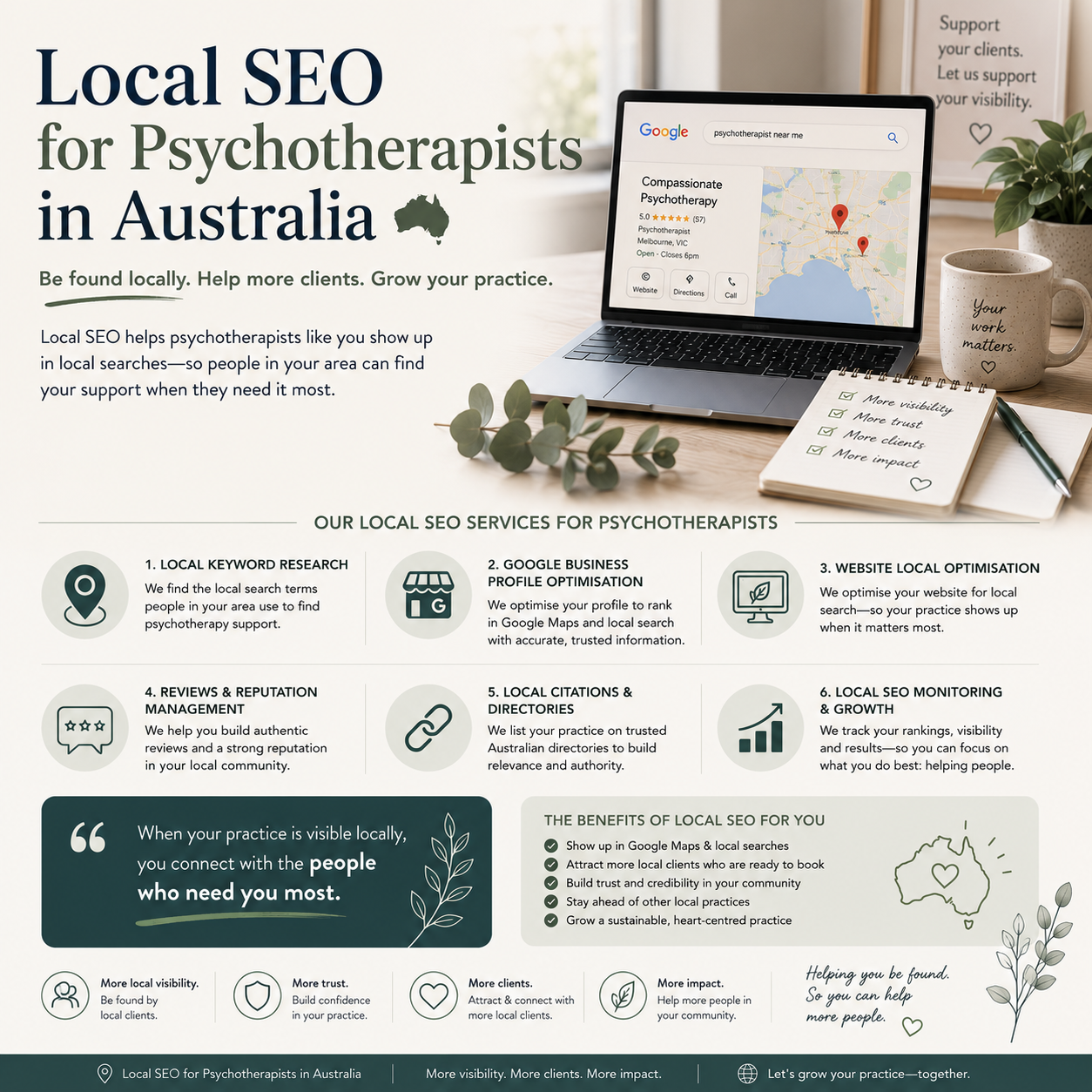
Local SEO for psychotherapists in Australia carries higher stakes than most local SEO work — clients are researching a deeply personal, high-trust decision, and the practitioners who rank consistently are the ones who make that research process feel safe and specific, not generic. This guide covers what local SEO for psychotherapists in Australia genuinely requires.
What Makes Psychotherapy Local SEO Different
Unlike a café or a gym, a psychotherapist's local SEO needs to satisfy Google's strictest YMYL scrutiny while still ranking for genuinely local, high-intent searches. Local SEO for psychotherapists in Australia has to hold both of these at once — visible, credible expertise and strong local pack presence.
Suburb-Level Strategy Over City-Wide Generic Pages
A psychotherapist in Sydney's inner west faces different competition and client expectations than one in a growth corridor suburb. We build this out at the suburb level across our Australia market coverage, since a single generic "Sydney psychotherapist" page rarely competes well against genuinely local content.
Trust Signals That Matter Most
AHPRA registration display (where applicable), clearly explained modalities, and genuine, specific client outcomes (within appropriate confidentiality bounds) all function as real ranking-adjacent trust signals within local SEO for psychotherapists in Australia.
The Neurodivergent-Affirming Angle
This is a particularly strong opportunity area for neurodivergent-affirming psychotherapists in Australia — a fast-growing, currently underserved specialism where families are actively searching for clinicians who understand both the clinical picture and the identity.
Where Practices Get This Wrong
The most common mistake within this is relying on a single, generic city-wide page instead of building genuinely distinct, suburb-specific content and citations that reflect where clients actually live and search.
A Realistic Timeline
Suburb-specific searches typically move within eight to twelve weeks; broader city-wide competitive terms can take four to six months, a timeline consistent across most of the this work we've done.
How to Measure Whether This Is Working
Track three numbers monthly rather than checking daily: total impressions in Google Search Console (a leading indicator that Google is testing your content against more queries), average position for your two or three priority terms, and actual click-throughs once positions start improving. Early-stage SEO work often shows impressions rising well before clicks do — that's a sign of progress, not a plateau, provided positions are also trending in the right direction over each four to six week window. Resist the urge to judge results weekly; ranking data is noisy over short windows and settles into a clearer trend only once a month or so of data has accumulated.
What a Realistic 90-Day Plan Looks Like
The first two to three weeks typically go to a technical and content audit, establishing a clear baseline before anything changes. Weeks three through six focus on foundational fixes and the highest-priority page or two. From there, content expands steadily on a fortnightly or monthly cadence rather than all at once, so early performance data can shape what gets built next rather than guessing upfront. By day ninety, most practices have a noticeably stronger technical foundation, several new or substantially improved pages, and enough performance data to make an informed decision about where to invest the following quarter's effort.
Where This Fits Into a Complete Strategy
None of this works well in isolation — technical health, content depth, local presence and AI visibility all reinforce each other rather than functioning as separate checkboxes. See our Wellness SEO service and case studies for how these pieces come together for practitioners already doing this well. The practices that see the fastest, most durable movement are almost always the ones treating this as one connected system rather than picking a single tactic and hoping it carries the whole strategy on its own.
What to Ask Before Committing Budget
Before committing meaningful budget to any of this, ask for a technical audit first, ask what a realistic 90-day outcome actually looks like given your specific starting point and market, and ask how progress will be reported to you in plain language rather than raw data exports. A partner unwilling to answer these clearly before being paid is worth reconsidering, regardless of how confident the initial pitch sounds.
The Long View Beyond the First Quarter
Most of the compounding value in this kind of work shows up after the first 90 days, not during it — content published early keeps earning rankings and citations for years afterward, and the technical foundation built early makes every future page easier to rank, not just the ones published this quarter. Treating the first quarter as a foundation-building phase rather than a finished result tends to set expectations that hold up well over the following year, and avoids the common trap of judging an entire strategy on its slowest-moving first few weeks.
Frequently Asked Questions
How is local SEO for psychotherapists different from local SEO for other professions?
Psychotherapy content faces Google's strictest YMYL scrutiny, meaning credential display and evidence-informed language matter more than in most other local business categories.
Which Australian cities have the most competitive psychotherapy SEO?
Sydney and Melbourne carry the heaviest competition; Brisbane, Perth and Adelaide currently offer more accessible opportunities in specific suburbs.
Is AHPRA registration important for psychotherapy SEO?
Where applicable, yes — it's a strong, verifiable trust signal for both clients and Google's quality systems.
How long does local SEO take for a psychotherapy practice?
Suburb-specific searches often move within 8 to 12 weeks; broader city-wide competitive terms can take 4 to 6 months.
Should a psychotherapist target one suburb or several?
Only suburbs genuinely served — spreading a single generic page across many suburbs performs worse than fewer, well-built, specific pages.
Do client testimonials help SEO for psychotherapists?
Specific, appropriately anonymised outcome descriptions help build trust signals, though psychotherapists must balance this carefully against confidentiality and professional guidelines.
Is Google Business Profile important for psychotherapists?
Yes, particularly for in-person practices — most psychotherapy searches carry strong local intent.
What's the biggest local SEO mistake psychotherapists make?
Relying on one generic city-wide page instead of building genuinely local, suburb-specific content and citations.
Does neurodivergent-affirming psychotherapy have distinct SEO needs in Australia?
Yes — this audience searches with different language and trust expectations than generic psychotherapy searches, and content should reflect that specifically.
Can AI visibility help psychotherapists get found?
Increasingly yes, as more people use AI assistants for early-stage, exploratory questions before searching Google for a named local practitioner.