July 9, 2026 · By Annanya Adyasha
90 Days to Visible: What a Neurodivergent-Affirming SEO Strategy Actually Looks Like
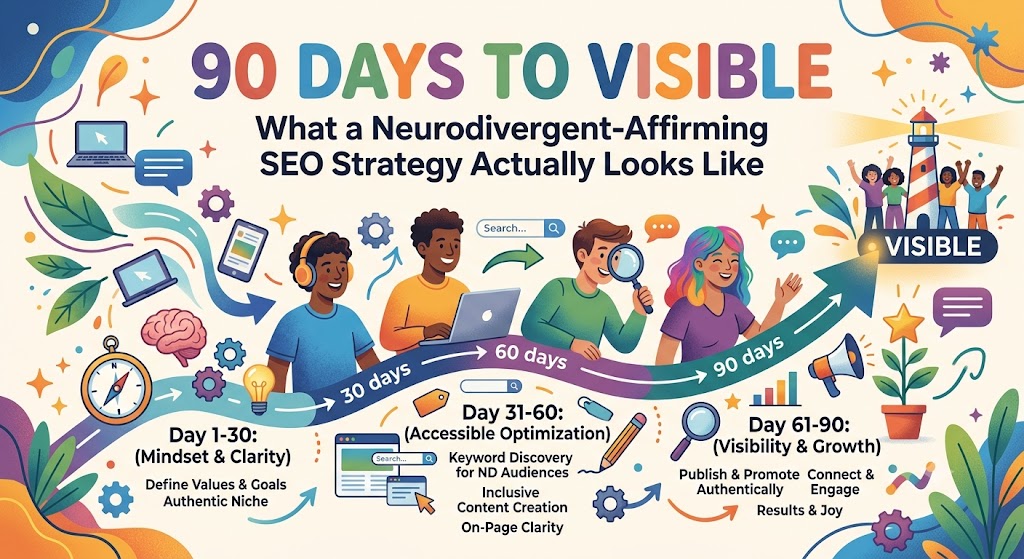
Most prospective clients ask a version of the same question before committing to any SEO engagement: what actually happens, and when will I see results? This SEO strategy timeline coach-focused walkthrough lays out a realistic 90-day sequence for a neurodivergent-affirming practice, rather than vague promises.
Every practice's starting point is different, so treat the day ranges below as a reasonable general framework rather than an exact guarantee — the underlying sequence and logic apply regardless of your specific timeline.
Setting the Stage for This Timeline
This 90-day framework describes a first engagement — the initial period of moving from little to no deliberate SEO or AI-visibility strategy toward a genuinely structured, specialized approach. Practices with existing SEO work in place will move through some phases faster, as noted throughout, but the overall sequence still applies as a useful mental model.
The goal of laying this out in detail isn't to promise a specific outcome by day 90 — it's to remove the ambiguity around what actually happens during an engagement like this, since vague timelines are one of the most common sources of frustration in SEO work generally.
Why a Defined Timeline Matters More in This Niche Specifically
Because neurodivergent-affirming practitioner marketing is still a comparatively young, fast-developing niche, practices entering it now benefit disproportionately from having a clear, structured process rather than an open-ended, reactive approach. A defined timeline creates natural checkpoints for evaluating whether the underlying strategy is working before too much time or budget has been committed.
This structure also makes it easier to communicate progress clearly, whether to a business partner, a practice manager, or simply to yourself as the person doing the work — knowing what should be true at day 30 versus day 90 removes much of the ambiguity that makes SEO feel opaque to practitioners without a marketing background.
Days 1–14: Audit and Baseline
The first two weeks focus entirely on diagnosis: a full technical and language audit against our neurodivergent-affirming checklist, plus a baseline AI-visibility check across ChatGPT, Perplexity, and Gemini to establish exactly where you stand before any changes are made.
This phase deliberately avoids making changes before the audit is complete. Fixing issues piecemeal before establishing a clear baseline makes it much harder to know later which changes actually drove which results.
Days 15–30: Foundational Fixes
This phase addresses technical fundamentals and core-page language — fixing the hidden costs of neurotypical-default SEO copy — before any new content is published, since new content built on an unfixed foundation underperforms.
Expect this phase to include heading structure cleanup, page-speed fixes, and a full rewrite pass on your homepage and top one or two service pages, since these carry the most weight for both search engines and first-time visitors.
Why Foundational Work Comes Before New Content
Publishing new content on top of technical or language issues tends to waste effort, since the underlying problems limit how well any new page can perform regardless of quality.
This is one of the most common reasons an otherwise well-written blog post underperforms — the content itself is fine, but a slow-loading site or confusing heading structure quietly caps how well it can ever rank.
Days 31–60: Core Content Cluster Build
This is when dedicated content clusters — such as the AuDHD-informed and autism-affirming clusters described in our related articles — get built out, along with schema markup and structured FAQ content that supports both traditional and AI-assistant visibility.
Content is published on a steady cadence during this phase rather than all at once, which allows early performance data on the first few pieces to inform adjustments to later ones in the same cluster.
Days 61–90: Proof, Measurement, and Iteration
The final phase focuses on adding proof content (case studies, testimonials), re-running the AI-visibility check from day one to measure real movement, and adjusting the content plan based on what's actually gaining traction rather than what was originally assumed.
What Realistic Success Looks Like at Day 90
Most practices following this sequence see measurable improvement in ranking keywords, some initial AI-assistant citation activity, and a clearer sense of which content clusters are working — not overnight dominance, but a genuinely stronger foundation than at day one.
Equally important, and easy to overlook: by day 90 you should also have a much clearer picture of which of your specific keyword targets and content angles are actually resonating, information that meaningfully sharpens the next 90 days of work rather than requiring a fresh guess each quarter.
How This Timeline Interacts With Ongoing Content Production
It's tempting to pause all other content production during the first 30 days of foundational fixes, but in practice, most engagements continue publishing at a light, steady cadence throughout — the foundational work simply takes priority for internal resourcing rather than fully replacing content output during that window.
This steady-cadence approach also means that by day 90, you have a more natural, organically-paced content library rather than a sudden burst followed by silence, which tends to read better to both search engines and returning visitors over time.
How to Adjust This Timeline for Your Own Starting Point
A practice with an already technically sound site can often compress the first 30 days significantly, moving into content cluster building sooner. A practice starting from a badly outdated or technically broken site may need to extend the foundational-fixes phase beyond day 30 before new content can be expected to perform.
The key principle to preserve regardless of pacing: complete the audit and foundational fixes before investing heavily in new content, since skipping this step tends to waste effort on content that can't perform to its potential.
Setting Realistic Expectations With Stakeholders
If you're presenting this timeline to a business partner, practice manager, or your own leadership, frame the 90-day window explicitly as a foundation-building period rather than promising specific ranking positions or traffic numbers by day 90 — a distinction that helps avoid disappointment even when the underlying work is genuinely on track.
What Happens After Day 90
The 90-day window is a starting foundation, not an end point. Ongoing quarterly audits, continued content expansion, and steady proof-content development are what turn early gains into durable, compounding visibility over the following year.
Frequently Asked Questions
Is 90 days enough to see real SEO results?
It's enough to see measurable foundational progress and early ranking movement, though full competitive dominance in any niche typically takes longer.
What happens in the first two weeks specifically?
A full technical and language audit plus a baseline AI-visibility check, establishing exactly where your practice currently stands.
Why does foundational work come before new content?
New content built on unresolved technical or language issues tends to underperform, since those underlying problems limit its potential regardless of quality.
What kind of content gets built during days 31 to 60?
Dedicated content clusters around your specific niche positioning, along with schema markup and FAQ content supporting AI visibility.
How is progress actually measured at day 90?
By comparing ranking keyword counts, organic traffic, and AI-assistant citation testing against the day-one baseline.
Does this timeline apply to coaches as well as licensed therapists?
Yes, the same 90-day structure applies across ADHD coaches, wellness coaches, and clinical practices, with content specifics adjusted per niche.
What if my practice already has some SEO work done?
The audit phase adjusts to account for existing work, focusing days 15 to 30 only on genuine gaps rather than starting from zero.
Is this a fixed timeline or does it vary by practice?
It's a realistic general framework; actual pacing can vary based on starting point, market competition, and resourcing.
Should I expect AI-assistant citations by day 90?
Some early citation activity is a reasonable goal in this specific niche, given the currently low level of competition.
What comes after day 90?
Ongoing content expansion, quarterly AI-visibility re-checks, and ongoing proof-content development, building on the foundation established in the first 90 days.