July 28, 2026 · By Anurag Paul Gummadi
Naturopathic Practice SEO Services: A Complete Guide
Introduction
Naturopathic practice SEO is more specialised than simply adding “naturopath” to a generic wellness SEO strategy. People may search for a naturopath by location, modality, condition, practitioner type, or a specific health question, while Google applies higher trust expectations to health-related content.
That makes the website’s job twofold: clearly explain what the practice actually offers and give search systems enough reliable information to understand the practitioner, services, expertise, location, and supporting content.
This guide explains how to build SEO for a naturopathic practice around those realities. It covers keyword strategy, service pages, local SEO, content, practitioner credibility, technical foundations, AI visibility, conversions, and a practical 90-day plan.
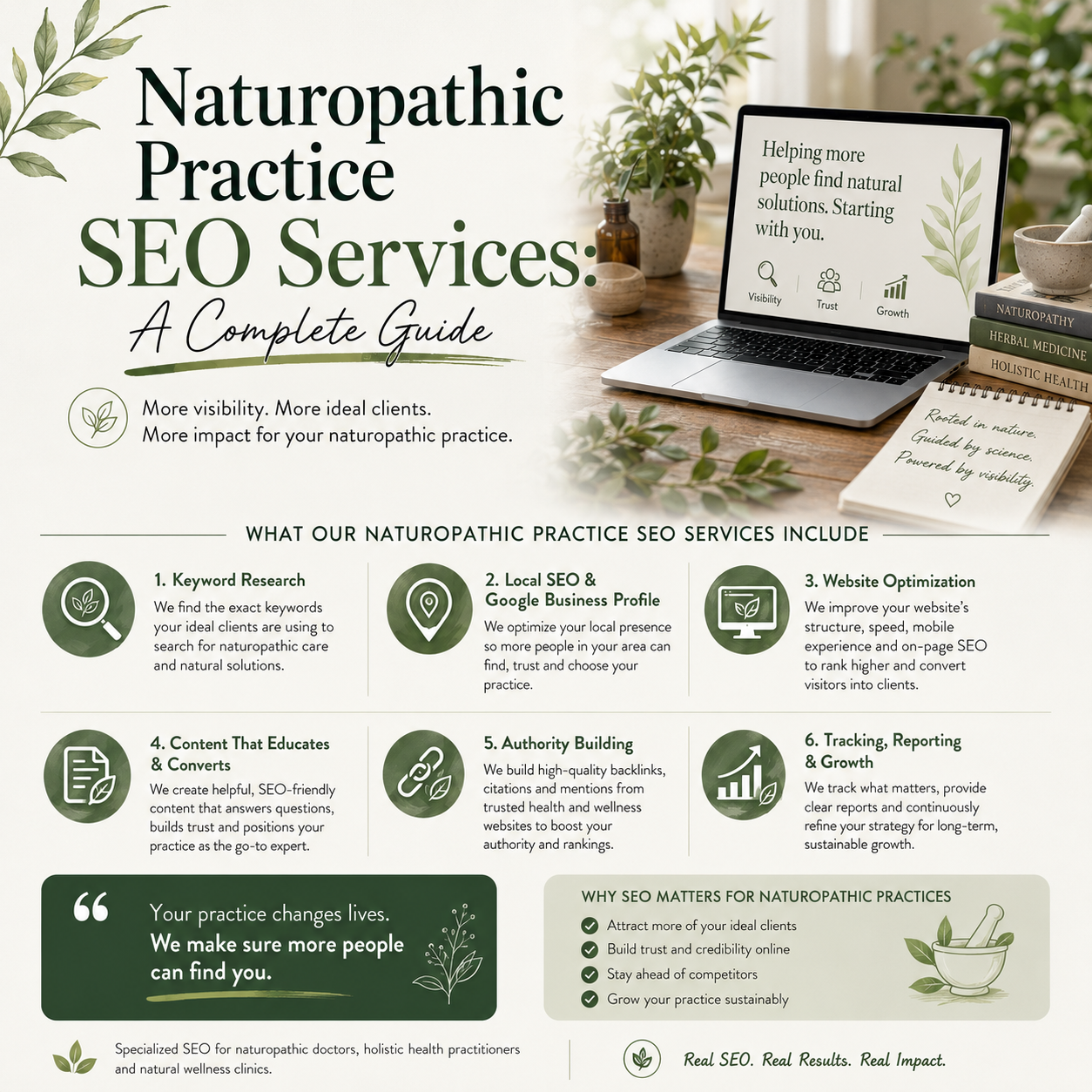
Naturopathic Practice SEO Services: What the Strategy Covers
Effective naturopathic practice SEO services connect technical SEO, local search, useful content, practitioner trust signals and AI visibility into one search strategy. The exact mix depends on the practice, its genuine areas of expertise, its locations and the services it actually provides.
- Keyword and search-intent research for naturopathic practices and genuine areas of focus
- Technical and on-page SEO, including titles, headings, internal links and indexability
- Local SEO and Google Business Profile optimisation for practices serving specific locations
- Content architecture built around real services, expertise and prospective-client questions
- Practitioner credibility and E-E-A-T signals, using accurate qualifications and professional information
- AI visibility foundations that make the practitioner, practice and services easier for AI systems to understand
For the broader strategy across wellness practices, see our Wellness SEO services.
Why Naturopathic SEO Needs a Specific Approach
Naturopathic content sits within health-related search, where accuracy and trust matter. Generic wellness copy can be too vague, while aggressive health marketing can make claims that are difficult to substantiate.
A strong naturopathic SEO strategy therefore starts with the practitioner’s real qualifications, modalities, areas of focus, locations, and services. Content should explain the practice clearly without promising outcomes that cannot be supported.
Annurya’s current naturopathic guide makes this same distinction: effective naturopathic SEO combines technical foundations, local SEO and Google Business Profile work, useful content, and relevant citations while communicating credentials and evidence-informed practice carefully.
What the Current Search Data Is Showing
The current Search Console analysis shows a meaningful naturopathic cluster rather than one isolated keyword. Recent data includes “naturopathic practice SEO services” at roughly position 80, “SEO for naturopathic practices” around position 81, and “SEO for naturopathic clinics” around position 76. Related searches such as “naturopath SEO” and “integrative medicine SEO” also appear.
Together, the core naturopathic queries represent roughly 200+ impressions in the analysed period. That is enough to justify a focused topical asset, but not enough reason to create several near-duplicate commercial pages.
The important finding is that Annurya already has a published article specifically targeting naturopathic practice SEO services. The right move is therefore to strengthen that existing URL into the authoritative guide for the cluster, then connect it to the existing Holistic & Alternative Health Practitioners page and the broader Wellness SEO service.
The current exports do not prove an exact query-to-page relationship for every search, so these figures should be treated as cluster-level signals rather than a claim that every query belongs to this article.
Keyword Strategy for Naturopathic Practices
The primary keyword should be “naturopathic practice SEO services,” because it matches the existing article and one of the strongest commercial signals in the current cluster.
Use related phrases naturally throughout the page: “SEO for naturopathic practices,” “SEO for naturopathic clinics,” “naturopath SEO,” “naturopathic SEO,” “naturopathic SEO services,” “SEO for naturopaths,” “local SEO for naturopaths,” “naturopath marketing,” and “naturopathic practice marketing.”
Semantic terms should include naturopath, naturopathic practitioner, naturopathic clinic, natural health, holistic health, integrative care, Google Business Profile, local search, practitioner credentials, E-E-A-T, health content, topical authority, and AI visibility.
Do not create separate articles for every keyword variation. The search intent overlaps substantially, so one comprehensive guide can cover the commercial topic while the existing practitioner page owns the service-specific conversion intent.
Build the Right Website Structure
A naturopathic practice should have a clear commercial page that explains the practitioner, services, areas of focus, location, credentials, and how to enquire. Supporting content can then answer narrower questions that prospective clients may research before contacting the practice.
The most useful structure is usually a commercial service page supported by educational content, not a blog full of disconnected articles. Each article should have a clear reason to exist and a contextual link to the relevant service.
Annurya’s existing Holistic & Alternative Health Practitioners page is a natural commercial supporting page because it already explicitly covers naturopaths alongside acupuncturists, herbalists, Ayurvedic practitioners, massage and bodywork practitioners, and integrative health clinics. The broader Wellness SEO service can support the overall commercial proposition.
Create Modality and Service Clusters
Naturopaths often work across multiple modalities and areas of focus. The website should reflect genuine expertise rather than trying to rank for every health topic.
For example, if a practice genuinely focuses on digestive health, the site can have a relevant service or expertise page supported by useful educational content. A practice focused on hormonal health, stress support, or another area can build a similar cluster when those topics genuinely match the practitioner’s work.
The key is to avoid publishing content simply because a keyword appears to have demand. Health content should be grounded in the practitioner’s actual expertise and written responsibly.
Each supporting article should answer a useful question and connect naturally to the relevant commercial page. This creates a topical relationship that is easier for visitors and search systems to understand.
Local SEO for Naturopaths
Local SEO is particularly important for many naturopathic practices because prospective clients often need to find a practitioner they can actually access. A strong local strategy begins with accurate business information and a properly configured Google Business Profile.
The website should make the practice location and service area clear. Important service pages should include genuine local relevance rather than simply inserting a city name into generic copy.
Reviews can support trust, but they should be genuine. Directory and citation work should also prioritise relevant platforms rather than building large numbers of low-quality listings.
If a practice serves several locations, create location pages only where there is a genuine service connection and enough unique information to make the page useful. Do not create dozens of interchangeable city pages simply to capture geographic keywords.
E-E-A-T and Practitioner Credibility
For a naturopathic practice, practitioner information is a core trust asset. The website should clearly identify who provides the service and accurately describe qualifications, professional experience, areas of focus, memberships, certifications, and other credentials that can genuinely be verified.
Health content should also distinguish education from individual medical advice. Avoid presenting broad health outcomes as guaranteed, and be careful with claims about conditions, treatments, or mechanisms.
Annurya’s current naturopathic strategy already emphasises credentials, evidence-informed language, and careful handling of health claims. That should remain central to the upgraded article rather than being replaced with generic marketing copy.
The goal is not to make the page sound clinical for the sake of SEO. It is to make the practice’s real expertise easier to understand and verify.
Technical SEO Foundations
Each important naturopathic page should have a unique title and meta description, one clear H1, logical headings, a canonical URL, crawlable internal links, useful mobile presentation, and a fast enough user experience.
The main naturopathic guide should not be isolated in the blog archive. It should connect to the Holistic & Alternative Health Practitioners page and the Wellness SEO service through contextual links. Relevant practitioner and service pages should link back where appropriate.
Use structured data only when it accurately represents information visible on the site. Professional, local-business, article, and FAQ markup can help search systems interpret page types when implemented correctly.
Search Console should be used to monitor indexing, queries, impressions, clicks, CTR, and average position. The objective is to improve the existing asset rather than repeatedly replacing it.
Content That Builds Naturopathic Authority
The strongest content strategy is built around the questions the practitioner is genuinely qualified to answer. Content can cover how the practice works, what a consultation involves, how the practitioner approaches a particular area of focus, and questions prospective clients commonly ask.
Condition-related content needs extra care. Do not make unsupported promises or imply that a naturopathic approach will produce a guaranteed medical outcome.
Where evidence is relevant, cite appropriate sources and distinguish established information from the practitioner’s approach or interpretation. Make authorship and review information visible where useful.
A useful article should also lead somewhere. If someone reads an educational guide about the practitioner’s area of focus, the page should make it easy to learn about the relevant service or practitioner without turning every paragraph into a sales pitch.
AI Visibility for Naturopathic Practices
AI visibility is becoming relevant to naturopathic search because prospective clients may ask broad questions about natural health, naturopathy, practitioners, or approaches to a particular concern before they ever search for a clinic.
The same trust foundations that help conventional SEO also support AI visibility: clear entity information, accurate credentials, useful content, consistent terminology, strong internal linking, and credible external references.
Annurya’s AI Visibility & GEO service can support this layer. For a naturopathic practice, the practical goal is to make the practitioner, organisation, services, expertise, and supporting content easy for AI systems to understand and verify.
AI visibility should remain an additional layer rather than a replacement for search fundamentals. Mentions and citations can vary across systems and prompts, so they should be monitored as a visibility signal rather than treated as a guaranteed traffic source.
Convert Searchers Into Enquiries
Search visibility only becomes commercially useful when visitors can understand the practice and take an appropriate next step.
The main service page should clearly explain who the practice is for, what services are available, where the practice operates, what an initial consultation involves, and how someone can contact or book.
Educational articles can use softer calls to action, such as exploring the relevant service page or practitioner profile. Avoid unsupported promises or pressure-based messaging.
Track meaningful actions in GA4 where possible. Form submissions, booking clicks, calls, and other enquiry actions tell you more about business value than page views alone.
A Practical 90-Day Naturopathic SEO Plan
Days 1–30 should establish the foundation. Review the existing naturopathic article, the Holistic & Alternative Health Practitioners page, practitioner information, internal links, titles and descriptions, indexing, technical issues, Google Business Profile, and conversion paths.
Days 31–60 should strengthen the highest-value gaps. Upgrade the main guide, improve the commercial practitioner page, add one or two genuinely useful supporting resources, and strengthen contextual internal links. Build citations or local signals only where they are relevant and legitimate.
Days 61–90 should be evidence-led. Review which queries are gaining impressions, which pages are moving, which searches generate clicks, and which content produces meaningful engagement. Expand topics where genuine expertise and search demand overlap.
The purpose of the first 90 days is to build a connected authority system and a reliable measurement baseline, not to promise a specific ranking or lead volume.
How to Measure Naturopathic SEO
Use Search Console to monitor impressions, clicks, CTR, average position, indexing, and query trends. Review both the overall naturopathic topic and individual page performance.
Use GA4 to understand what happens after a visitor arrives. Useful signals include engaged sessions, service-page visits, enquiry interactions, booking actions, and completed lead events.
For Annurya, the current cluster data shows visibility exists but the main naturopathic commercial queries are still relatively far from page one. That makes this a strengthening opportunity rather than a page-one maintenance exercise.
Avoid making multiple major changes at the same time. Document what changes, request indexing, and then allow enough time for Search Console data to show whether the revised page is moving in the intended direction.
Final Takeaway
Naturopathic practice SEO works best when the website becomes a clear, trustworthy representation of the actual practitioner and practice.
Build around real services, genuine expertise, local relevance, accurate credentials, useful content, strong internal linking, and careful health claims. Use one authoritative guide for the overlapping commercial SEO topic rather than creating multiple pages for minor keyword variations.
For Annurya, the existing naturopathic article already has the right strategic foundation. The opportunity is to strengthen that asset and connect it more deliberately with the Holistic & Alternative Health Practitioners page, Wellness SEO service, and AI Visibility offering.
The goal is straightforward: make a qualified naturopathic practice easier to understand, discover, trust, and contact when someone is actively searching for the kind of help it genuinely provides.
Frequently Asked Questions
What is naturopathic practice SEO?
It is the process of improving a naturopathic practice website so relevant clients can discover its services, expertise, location and practitioner information through search engines.
Why is SEO different for naturopathic practices?
Naturopathic websites operate within health-related search, so practitioner credibility, careful claims, useful content and trust signals matter alongside normal technical and local SEO.
What keywords should a naturopath target?
Start with genuine services and expertise, such as naturopath, naturopathic practice, naturopathic SEO, local SEO for naturopaths, naturopathic services and accurate location-based searches.
Is local SEO important for naturopaths?
Yes, particularly for practices that depend on in-person appointments. Accurate business information, Google Business Profile optimisation, relevant local pages and genuine reviews can support local discovery.
Should a naturopath create a page for every health condition?
No. Build content around conditions and topics that genuinely match the practitioner’s expertise and can be discussed responsibly.
How important are naturopathic credentials for SEO?
They are an important trust signal. The website should accurately explain the practitioner’s real qualifications, experience, areas of focus and relevant professional information.
Can naturopathic practices benefit from AI visibility?
Yes. Clear practitioner information, useful content, consistent terminology and credible references can make the practice easier for AI systems to understand and potentially cite.
Should the practitioner write the SEO content?
Practitioner input is valuable for accuracy and expertise. An SEO writer can then structure and optimise the content while preserving the practitioner’s factual knowledge and voice.
How long does naturopathic SEO take?
There is no universal timeline. Competitive local and health-related searches can require sustained technical, content, local and authority work over several months.
How should a naturopath measure SEO success?
Track Search Console impressions, clicks, CTR and positions alongside GA4 engagement, service-page visits, enquiries, booking actions and other meaningful conversions.
Editorial References
· Google Search Central — Creating Helpful, Reliable, People-First Content
· Google Search Central — SEO Starter Guide
· Annurya — Naturopathic Practice SEO Services