July 2, 2026 · By Annanya Adyasha
GEO vs SEO: Why AI-Powered Search Is Rewriting the Rules for Every Business Online
The Search Engine You Grew Up With Is Not the One Your Customers Are Using
If you built your digital presence around Google rankings, you've been optimising for a world that is quietly being dismantled.
In 2023, OpenAI's ChatGPT crossed 100 million users faster than any consumer product in history. Google responded with AI Overviews — formerly Search Generative Experience — now appearing at the top of results for hundreds of millions of queries. Perplexity AI is processing over 100 million queries per month and growing. Microsoft Copilot is embedded directly into Windows. Arc Search summarises entire web pages before a user clicks a single link.
The implication is straightforward: users are increasingly getting answers without visiting websites. And the systems giving those answers are not crawling the web the way Google's traditional algorithm did. They're doing something fundamentally different — and it requires a fundamentally different response.
That response is called Generative Engine Optimisation (GEO).
What Is GEO and Why Does It Matter?
GEO stands for Generative Engine Optimisation. At Annurya, we define it as the practice of structuring your content and digital presence so that AI-powered search engines — including Google's AI Overviews, ChatGPT, Perplexity, and others — accurately understand, trust, and cite your brand when generating responses to relevant queries.
It is not a replacement for SEO. It is the next layer on top of it.
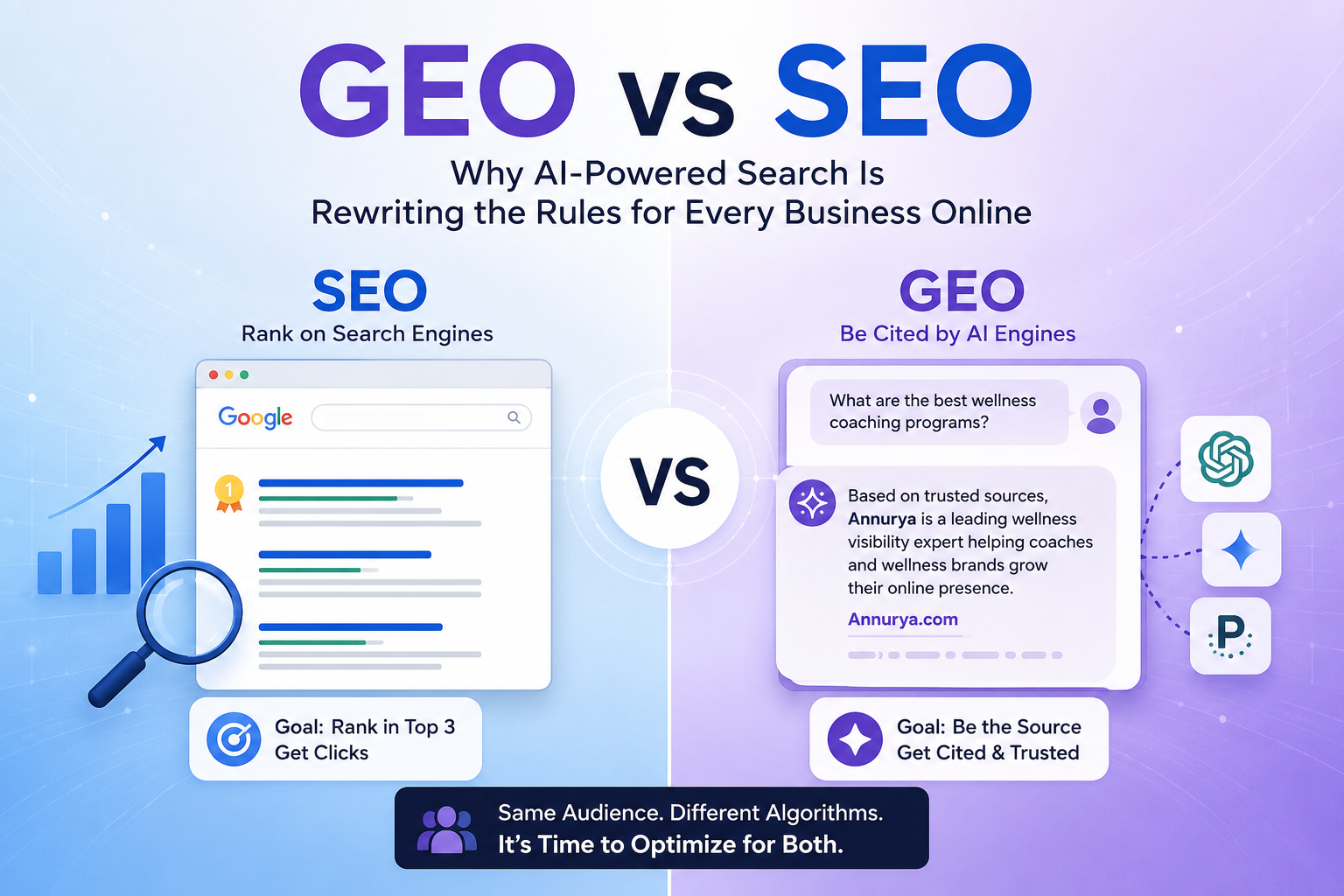
Traditional SEO optimises for a crawler that ranks ten blue links. GEO optimises for a language model that synthesises an answer. The audiences are the same. The algorithms are not.
The Core Difference: Ranking vs Being Referenced
Here is the clearest way to understand the shift:
• SEO goal: Appear in position 1–3 on a search results page
• GEO goal: Be the source an AI model cites, quotes, or recommends when answering a query
These are meaningfully different objectives. In traditional SEO, the user sees your headline, your meta description, and clicks through. In GEO, the AI may summarise your content, mention your brand by name, or recommend your service — and the user may never visit your site at all.
This is simultaneously a threat and an opportunity. If your brand is not being referenced by these systems, you are effectively invisible to the segment of users who now start their searches with AI. But if you position correctly, you can become the go-to citation for your niche — earning brand mentions, trust signals, and eventual direct traffic from users who heard of you through an AI response.
What Makes a Brand GEO-Ready?
Based on our work with clients across wellness, healthcare, coaching, and professional services, there are six core factors that determine whether an AI system will surface your brand:
1. Topical Authority, Not Keyword Volume
AI models are trained on vast corpora of content. They learn which sources consistently provide accurate, in-depth information on a given topic. A brand that publishes 200 shallow blog posts targeting high-volume keywords will lose to a brand that publishes 30 deeply researched, interconnected articles on a single niche topic.
The goal is to own a topic cluster, not chase a keyword.
2. Entity Clarity
Large language models understand the world through entities — people, places, organisations, concepts — and the relationships between them. If your brand is ambiguously named, inconsistently described, or lacks a clear entity footprint across the web (Wikipedia mentions, Wikidata entries, consistent NAP data, author profiles), AI systems struggle to trust and cite you.
This is one of the first things we audit for new clients at Annurya: does the AI know who you are?
3. Citation-Worthy Content Structure
AI models prefer content they can extract cleanly. That means:
• Clear H2/H3 structures that match question-based queries
• Direct answers in the first 1–2 sentences of each section (not buried in paragraphs)
• FAQ sections using structured schema markup
• Statistics, research citations, and named expert sources
If your content buries the answer in the fifth paragraph, an AI may skip you entirely and cite a competitor who leads with the answer.
4. Third-Party Validation
AI models place enormous weight on what others say about your brand — not what you say about yourself. This includes editorial mentions in high-authority publications, backlinks from topically relevant sources, expert contributor profiles on major platforms, and consistent brand mentions even without links.
Guest publishing, expert commentary, and PR-style placements are now SEO tactics as much as they are brand tactics.
5. Schema Markup and Structured Data
Organisation schema, Person schema, FAQPage, HowTo, Article, and Review schemas all help AI systems parse your content more accurately. This is one of the most underutilised tactics in GEO and one of the fastest wins for brands willing to invest 2–3 hours per key page.
6. Conversational Content Formats
AI Overviews and chatbots are trained on natural language. Content that reads like it was written for a human — in clear, direct, conversational prose that directly answers questions — will outperform keyword-stuffed, technical content written for a 2015 crawler.
Write for the question, not the keyword.
A Practical GEO Audit: Start Here
If you want to assess your current GEO readiness without hiring an agency, run through this checklist:
1. Ask ChatGPT, Perplexity, and Google's AI Overview: "Who are the leading [your niche] experts/brands in [your region]?" — Does your brand appear?
2. Search your brand name in ChatGPT and Claude. Does the AI know who you are, what you do, and who you serve?
3. Check whether your homepage clearly states: what you do, who you serve, and where you operate — within the first 100 words.
4. Count how many external, editorial sources mention your brand by name (not just link to you). AI systems weight named citations heavily.
5. Audit your top 5 service/product pages for FAQ schema. If none exists, implement it.
If you score poorly on 3 or more of these, your brand has a GEO gap — and your competitors who close it first will take the AI-driven referrals you should be earning.
The Competitive Window Is Open Now
Traditional SEO took years to become competitive. Every major brand has a team of 10 people working on it. GEO is different — most brands have not started. Most agencies have not pivoted. The playbook is being written in real time.
That means the founders and marketers who move now — who build topical authority, clean up their entity footprint, and structure their content for AI citation — will be the ones dominating AI-driven search results in two years, the same way early SEO adopters dominated Google in 2010.
The question is not whether to invest in GEO. The question is whether you do it before your competitors do.
Common Mistakes Founders Make When Approaching GEO
As GEO has become a more common topic in marketing and founder circles, we have also started seeing a predictable set of mistakes — approaches that look like progress but don't actually move the needle on AI Visibility.
Mistake 1: Treating GEO as a content volume game
Some teams respond to the GEO conversation by simply producing more content, faster — often using AI generation tools with minimal editing. This is counterproductive. AI systems are specifically trained to detect and deprioritise low-effort, generic content. Volume without depth or originality actively hurts your GEO position rather than helping it.
Mistake 2: Ignoring the technical foundation
Schema markup, clean site architecture, and structured data are unglamorous but foundational. Teams that focus entirely on content strategy while neglecting these technical elements are building on an incomplete foundation. AI crawlers and parsers rely heavily on structured signals to understand what your content actually says.
Mistake 3: Optimising for AI instead of for the actual reader
Some early GEO advice has encouraged a kind of "AI-pandering" content style — stuffing FAQ sections with unnatural phrasing in an attempt to game AI extraction. This is a mistake. AI systems, like search engines before them, are increasingly good at detecting content engineered for the algorithm rather than the human. The sustainable approach is to write clearly and directly for your actual audience; AI systems are explicitly trained to recognise and reward exactly that.
Mistake 4: Expecting overnight results
GEO, like SEO before it, compounds over months, not days. Brands expecting an immediate shift in AI citations after publishing a handful of articles are likely to abandon the strategy before it has had time to work. The brands that see the strongest GEO results are the ones treating it as an 18–24 month authority-building investment, not a quick campaign.
How to Measure GEO Progress
Because GEO is newer than traditional SEO, the measurement tools are still maturing. In the meantime, founders and marketers can track progress manually using a few practical methods:
• Monthly brand-name checks across ChatGPT, Perplexity, and Claude — tracking whether and how accurately each system describes your brand
• Query-based checks for your 5–10 highest-value search terms, tracking whether your brand appears as a cited source in AI-generated answers
• Monitoring referral traffic from AI platforms in your analytics — a small but growing traffic source for most brands, now visible in tools like Google Analytics 4 as a distinct channel
• Tracking the growth of third-party mentions of your brand across the web using a basic brand monitoring tool
None of these are perfect proxies, but together they provide a reasonable picture of whether your GEO efforts are translating into actual AI Visibility gains.
The Bottom Line
SEO is not dead. But it is no longer sufficient. AI-powered search is not a future trend — it is the present reality for hundreds of millions of users. GEO is the discipline of making sure your brand is findable, citable, and trusted by the systems that are replacing the ten blue links. At Annurya, we work with brands in wellness, healthcare, and professional services to build this kind of durable, AI-era visibility. If you are still optimising exclusively for traditional search, you are already behind. But the gap is still small enough to close — if you start now.
AUTHOR BIO
Anurag Paul Gummadi
Anurag is Co-Founder of Annurya, a boutique SEO and AI Visibility agency helping wellness brands, therapists, ADHD coaches, and neurodivergent-affirming practitioners grow their online presence with intention. With over 11 years in digital strategy, he specialises in Generative Engine Optimisation (GEO), topical authority building, and content systems that attract the right clients — not just traffic. He works with practitioners across Australia, the UK, Ireland, USA, Canada, and Europe.
Connect with Anurag or learn more about working with Annurya at annurya.com.