2026-10-09 · By Anurag Paul Gummadi
How Wellness Coaches Can Become AI Recommended
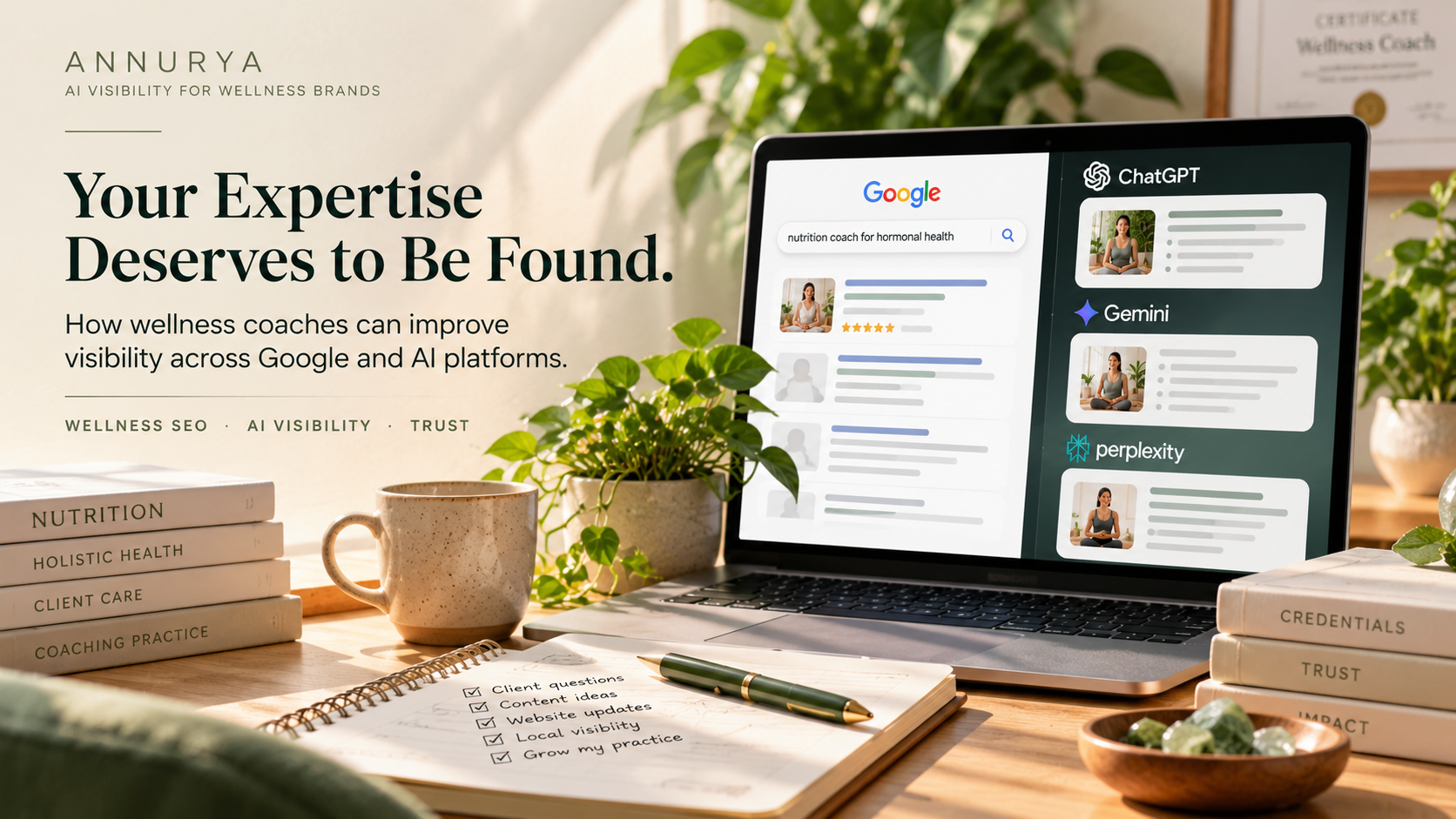
Wellness professionals are no longer discovered through search engines alone. Prospective clients may search Google, browse professional directories, or ask AI tools for guidance on finding a coach who fits their needs. A strong online presence needs to help people and digital systems understand the same things: who you help, what you offer, what qualifies you to offer it, and how someone can take the next step.
Discovery Now Happens Beyond Search
A prospective client might search for a nutrition coach in their city or ask ChatGPT, Gemini, or Perplexity to suggest a professional who understands a particular goal. That does not mean traditional SEO has disappeared. It means discovery can happen across both familiar search results and AI-generated answers.
Being mentioned in an AI answer is not the same as earning a trustworthy recommendation. Health and wellness decisions require clear, verifiable details about a practitioner's credentials, specialty, services, and professional scope. Google's guidance on [creating helpful, reliable, people-first content](https://developers.google.com/search/docs/fundamentals/creating-helpful-content) emphasizes usefulness, trust, and clear responsibility for content, particularly when information may affect people's wellbeing.
Visibility is therefore not just a publishing task. It involves clear positioning, useful answers to real client questions, consistent professional information, and a website that search systems can access and interpret. A connected wellness SEO and AI visibility strategy can help bring these elements together. No tactic, however, guarantees that an AI platform will cite or recommend a particular practitioner.
1. Make Your Expertise Easy to Verify
Start by explaining your work in specific, everyday language. State who you help, the goals or concerns you support, how your coaching works, and what clients can reasonably expect from the process. Avoid broad claims that could describe almost any practitioner.
Describe your training and credentials accurately, and explain the boundaries of your service. If a concern falls outside your qualifications or requires clinical care, make that distinction clear. Transparent boundaries help prospective clients decide whether your service is appropriate and prevent your content from implying that coaching replaces diagnosis or treatment.
Use the same practitioner name, credentials, specialties, and business details across your website, professional directories, and credible third-party profiles. Inconsistent information can make it harder for people to determine whether different profiles refer to the same professional.
Make authorship visible on educational pages. Include an accurate byline, link to a biography with relevant experience, and identify a qualified reviewer where appropriate. Keep claims evidence-informed and cite sources when discussing research. These are sound trust-building practices, not guaranteed ranking factors or confirmed triggers for AI citations.
2. Write for the Questions Real Clients Ask
The most useful content plan begins with the language prospective clients already use. Review enquiry forms, consultation questions, emails, and relevant search queries. Look for recurring questions about the problem they want help with, how coaching works, what it costs, what qualifications matter, and how to choose a practitioner.
Build pages around distinct needs rather than repeating a broad phrase such as âÂÂwellness coachâ across every page. A service page should explain who the service is for, the approach, relevant qualifications, what sessions involve, and how to enquire. Supporting articles can answer questions people ask before they are ready to book.
Use descriptive page titles, clear headings, direct answers, and useful FAQs. Cover the subject as fully as readers need, but do not add length simply to reach a word count. Original insights, practical examples, accurate sourcing, and a clear connection to your actual experience are more valuable than generic articles that rephrase existing material.
If you want to build this into a structured search strategy, read Annurya's guide on how wellness coaches can rank on Google. It covers service-page intent, supporting content, internal links, and the relationship between informational articles and commercial pages.
Organise related content into a useful topic cluster. A main service page can link to relevant educational articles, while those articles link back to the service page when it is a natural next step. This creates a helpful path for readers and gives search engines clearer context about how your pages relate.
3. Build a Clear Technical Foundation
Strong content still needs to be discoverable. Check that important pages can be crawled and indexed, that navigation works, and that the site loads reliably on mobile. Review page experience and Core Web Vitals, fix broken links, and make sure service and practitioner pages are not isolated from the rest of the site.
Use internal links to connect your homepage, practitioner biography, service pages, location information, and educational resources. Keep your name, credentials, contact details, and service information consistent throughout the site. Where it accurately describes the page, structured data can help identify a person, service, FAQ, or local business. Schema clarifies information; it does not guarantee rich results or AI recommendations.
A technical review should also check sitemap availability, robots directives, canonical tags, redirects, and whether key content is available in the rendered page. Do not assume that publishing more articles will solve an indexing or access problem.
4. Strengthen Local and Independent Trust Signals
If you meet clients in person or serve a defined region, make your location and service area clear. For eligible businesses, keep your Google Business Profile accurate and correctly categorised. Make sure the website describes the services and locations you genuinely serve, and keep business details consistent across relevant listings.
For a more detailed local checklist, see Annurya's guide to local SEO for wellness practitioners. It explains how service pages, location details, reviews, and useful local content can work together.
Choose third-party directories and professional profiles for relevance and credibility, not sheer quantity. A small number of accurate, respected listings can be more useful than a large collection of thin profiles. Invite genuine reviews from clients who choose to share their experiences, and never fabricate reviews or promise outcomes.
Independent references can help prospective clients verify who you are, but reviews and directory listings do not guarantee that an AI platform will cite or recommend you. Keep the goal grounded: make your professional identity easier to check and your services easier to understand.
5. Use Evidence Carefully and Avoid Promising Outcomes
Wellness content can influence decisions about health and wellbeing, so confident wording is not enough. Cite the research behind claims, confirm that the evidence supports the point being made, and explain uncertainty in language readers can understand. If a study has limitations, describe them rather than presenting one result as a universal rule.
When discussing outcomes, distinguish between findings across a group and what an individual client may experience. Explain the process you support, such as goal-setting, reflection, or building self-management strategies, without guaranteeing a specific health result.
Make the boundary between coaching and clinical care explicit. Explain what your service includes, what falls outside your qualifications, and when someone should seek help from a qualified health professional. This protects readers and helps them judge whether your service is appropriate.
6. Keep AI Use Human-Led and Safe
AI tools can help brainstorm topics, organise a first draft, or simplify administrative work. They should not replace professional judgement or become an unchecked source of health information. Verify health-related claims against authoritative sources, remove invented details, and edit the final material so it reflects your expertise, audience, and scope.
Protect client privacy. Do not enter identifiable client information into an AI tool unless its use is properly authorised and meets applicable privacy requirements. Use anonymised examples for brainstorming, review client-facing material before sharing it, and be transparent about AI assistance where appropriate.
AI platforms themselves should not be described as a reliable source of referrals or as systems that rank practitioners according to a known checklist. Their answers can change, and their internal recommendation processes are not fully transparent. Build a trustworthy digital presence because it helps people assess your work, not because it guarantees an AI mention.
7. Show the Human Value of Coaching
Your website should explain the service that AI cannot provide on your behalf: a human, client-centred process. Describe what happens in sessions, how goals are agreed, how progress is reviewed, and how you help clients work through obstacles or adjust plans.
People need to understand how your approach differs from general information or an automated suggestion. Explain the conversation, reflection, accountability, and collaborative planning involved, while avoiding claims that every client will achieve the same result.
Make your training, experience, intended audience, and professional boundaries easy to find. Clear information supports a better decision for the visitor and makes your online presence more coherent across channels.
8. Measure Visibility and Enquiries, Not Just Mentions
Review several signals together. Google Search Console can show impressions, clicks, queries, and landing pages. Analytics can show which pages bring visitors and whether they continue to enquiry or booking actions. For eligible local businesses, review relevant profile activity as well.
You can also test a small set of audience-specific prompts in AI platforms, such as questions about your specialty, approach, or location. Record the exact prompt and date, then repeat the test later. AI answers vary, so treat each mention as an observation rather than a stable ranking or promised result.
Use the data to identify practical gaps: a service page that does not explain who it serves, missing credentials, inconsistent business details, unanswered questions, or a weak next step. Measure whether visibility is contributing to relevant enquiries, not simply whether traffic is increasing.
If you are evaluating what support you need, Annurya's article on what a wellness SEO agency actually does explains how technical SEO, content, local visibility, and AI visibility can fit into one connected strategy.
9. Build a Practical Improvement Plan
You do not need to overhaul everything at once. Work through a manageable sequence:
- Clarify your positioning: who you help, what you offer, and where your professional scope ends.
- Improve your priority service page and practitioner biography so credentials, approach, and next steps are easy to find.
- Check crawlability, indexing, mobile usability, broken links, and structured data where relevant.
- Create or refresh a small number of useful articles based on real client questions.
- Connect those articles to relevant service pages with descriptive, natural internal links.
- Review your business profiles and credible third-party references for accuracy and consistency.
- Track search performance, useful visits, enquiries, and AI visibility observations over time.
This sequence prioritises the foundations before adding more content. It also makes progress easier to assess because each change has a clear purpose.
Conclusion: Earn Trust Before Chasing Visibility
There is no switch that makes an AI platform recommend a wellness coach. SEO and AI visibility work can make your expertise easier to understand and your content easier to discover, but citations and recommendations remain outside your control.
Start with the pages prospective clients rely on: your service descriptions, practitioner biography, and educational resources. Explain who you help, what your coaching includes, and where its scope ends. Keep claims accurate, identify the people responsible for the content, and make credentials and contact details consistent across your website and relevant professional profiles.
For a broader view of how these elements fit together, explore Annurya's wellness SEO and AI visibility services. The goal is not to chase every new platform. It is to build a clear, credible online presence that helps the right people understand your work and decide whether it fits their needs.