September 21, 2026 · By Annanya Adyasha
How ChatGPT Decides to Recommend Health Professionals
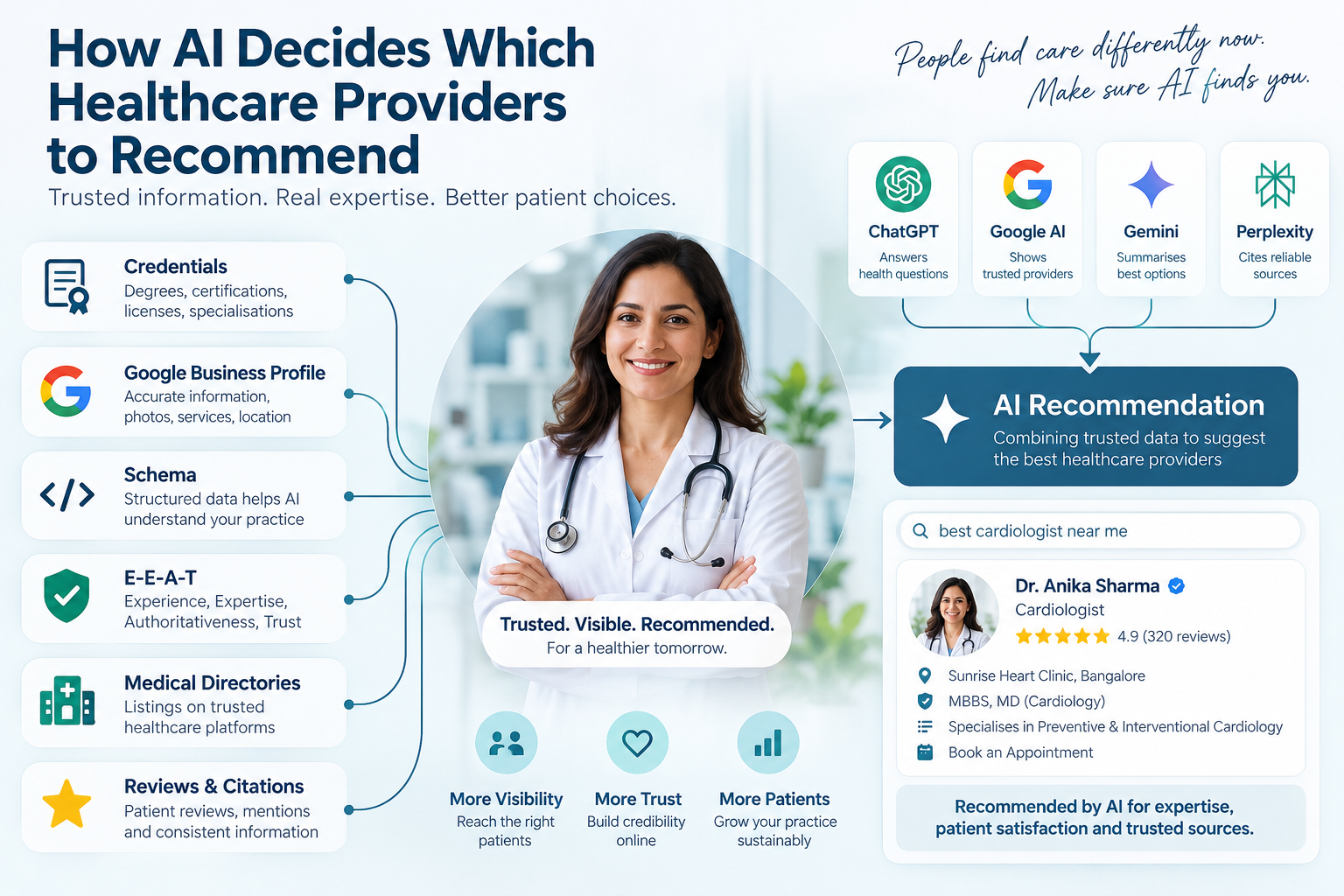
More than 230 million people globally ask ChatGPT health-related questions every week, according to OpenAI's de-identified analysis. That scale means AI has effectively become a first point of contact for countless patients deciding which provider to see.
The stakes are high. A 2025 patient-choice report found that 26% of patients said an AI tool influenced their choice of provider. When a chatbot recommends one practitioner over another, the decision carries real consequences for patient safety, trust, and clinical outcomes.
ChatGPT does not rely on star ratings or Google rankings alone. Instead, it evaluates a practice's entity confidence — how consistently a provider's name, address, phone number, specialty, and credentials appear across authoritative sources like the Google Business Profile, medical directories, hospital affiliation pages, and the practice's own website. Whether a professional gets recommended depends on structured trust signals that are often invisible to the practice itself.
For wellness professionals and health-focused brands, this shift changes the rules of online visibility. Being an excellent clinician is no longer enough; your practice must also be an entity that AI can verify with certainty. The sections that follow show exactly how ChatGPT evaluates providers, what signals earn a recommendation, and how Annurya helps practitioners build the structured credibility that AI platforms demand.
How The Top Doctors Actually Use ChatGPT Now
Entity Confidence and How It Drives Provider Selection
 When a patient asks ChatGPT for a doctor recommendation, the model does not sort by star ratings or Google rank. Instead, it relies on 'entity confidence' — a measure of how consistently a practice's identifying details appear across multiple trusted sources. The more sources that agree on a practice's name, address, phone number, and specialty, the higher the model's confidence that the practice is real and reliable.
ChatGPT's recommendation process follows five defined steps:
(1) interpreting the query for specialty, location, and intent;
(2) reviewing its training data;
(3) retrieving live web sources for current information;
(4) weighting those sources by authority and consistency; and
(5) generating an answer that names the one to three practices with the highest entity confidence.
This pipeline means that a practice's online identity must be uniform across its own website, its Google Business Profile, and medical directories such as Healthgrades and Zocdoc (or Practo and Lybrate in India).
Consistency across these sources matters more than review volume or search engine rank. ChatGPT reads the same open web that Google indexes, but it does not use Google's ranking algorithm — its own retrieval layer examines the raw data for agreement. A practice with clean, matching records across directories and a schema-marked website can be recommended alongside large hospital systems, even if it is a smaller independent clinic.
Live retrieval is the mechanism that makes this possible. Training data alone rarely includes independent doctors because they are too small to be memorized. By pulling current web information at query time, ChatGPT can surface smaller practices — provided their public profiles are current and consistent. For Annurya's wellness professionals, this means structured data and verified directory listings are the foundation of AI visibility, not a nice-to-have addition.
The Trust Signals That Differentiate a Healthcare Provider
 When a patient asks ChatGPT for a doctor, the model does not check for a friendly bedside manner or a clean waiting room. It checks for verifiable credentials: a national provider identifier, a medical license, a board certification. These signals separate legally recognized healthcare providers from general wellness practitioners in the AI's decision-making process.
A healthcare provider is a credentialed professional operating within a regulated framework that enforces standards of care, privacy, and accountability. A general wellness coach or lifestyle advisor may offer valuable guidance, but without formal accreditation, they lack the trust signals AI platforms use to reduce liability and ensure user safety. Large language models like ChatGPT and Gemini are trained to prioritize authoritative, verifiable sources, meaning wellness professionals without clear credentials risk being overlooked by AI for medical or clinical queries.
Structured data, such as schema markup on a practice's website, helps AI confirm a provider's identity and status. When a practitioner's name, specialty, license number, and institutional affiliations appear consistently across multiple indexed sources, the model treats that agreement as proof of reliability. This is the same mechanism that drives entity confidence: repetition across authoritative sources builds the trust an AI needs to confidently recommend a provider.
For health professionals aiming to appear in AI recommendations, the path forward is clear. Ensure that credentials are published on the practice website, listed on medical directories, and coded with structured data. Annurya's wellness SEO and AI visibility services help practitioners create and maintain these trust signals, making them verifiable authority online for platforms like ChatGPT and Gemini. Without this foundation, a provider's expertise remains invisible to the systems that now guide patient choices.
ChatGPT for Clinicians and Its Role in Professional Recommendations
 OpenAI launched ChatGPT for Clinicians as a dedicated workspace for verified healthcare professionals in the United States. The tool provides clinical search with cited answers from peer-reviewed medical sources, along with pre-built skills for tasks like drafting referral letters, prior authorization, and patient instructions.
Physician Feedback and Accuracy Validation
Before release, physician advisors tested 6,924 conversations in daily clinical work and rated 99.6% of responses as safe and accurate. A 2026 AMA survey found that 72% of physicians now use AI in clinical practice, up from 48% the previous year. OpenAI’s advisors have reviewed more than 700,000 model responses, with a new response reviewed every few minutes. The tool is evaluated against HealthBench Professional, an open benchmark for real clinician chat tasks where GPT-5.4 outperforms both other models and human physicians.
Verification and Data Integration
Access requires a valid NPI and a license verifiable through a third-party provider. Inside the workspace, clinicians can install the Healthcare Public Data plugin to connect read-only sources like the NPI Registry, PubMed, ClinicalTrials.gov, and CMS Open Data. This means a physician can search the NPI Registry for a specialist’s credentials or pull the latest treatment guidelines from PubMed directly within the same chat interface — making it easier to verify and recommend other providers.
Generative Engine Optimization: A New Path to AI Visibility
Traditional search engine optimization (SEO) focuses on ranking a link in a list of Google results. Generative Engine Optimization (GEO) shifts that focus entirely: it optimizes a practice's digital presence so that AI models like ChatGPT, Gemini, and Perplexity feature the practice directly in their generated answers. For wellness professionals, this is the difference between being a search result and being the trusted source an AI recommends.
GEO prioritizes authority signals over keyword density. The core framework is Google's E-E-A-T standards: Experience, Expertise, Authoritativeness, and Trustworthiness. AI models favor content that demonstrates real-world clinical experience, cites peer-reviewed journals rather than marketing copy, and comes from a clearly identified author. Content structured in a conversational, question-and-answer format also performs well, since that matches how patients phrase queries to chatbots.
The Foundation: Google Business Profile and Structured Data
The single most important data source for local AI visibility is a complete Google Business Profile. The name, address, phone number, hours, and services must be exact and consistent across every online directory. ChatGPT's retrieval layer reads the same open web as Google, and it treats identical information repeated across multiple sources as proof of a practice's existence and reliability. Schema markup—structured code added to a website—further helps AI interpret data like physician names, board certifications, accepted insurance plans, and patient reviews with perfect clarity.
Content That Builds AI Trust
Long-form, educational content that thoroughly answers patient questions is a GEO pillar. Pillar pages covering a core specialty—such as
Detailed provider biographies are equally important. A bio that includes medical school, board certifications, fellowships, publications, and a personal care philosophy signals deep expertise to AI. Clear authorship on every page—listing the clinician's name, title, and institutional affiliation—further boosts trust signals. Annurya helps health professionals structure these trust signals across their entire digital footprint, ensuring that the information AI retrieves is both consistent and authoritative.
E-E-A-T Content. Demonstrates real clinical experience, cites peer-reviewed journals, and names a specific author.Structured Data. Schema markup that labels physician names, board certifications, and insurance plans so AI reads them with certainty.Google Business Profile. A complete, consistent profile that serves as the single source of truth for local AI search.Long-Form Pillar Pages. Comprehensive articles covering a specialty from symptoms through recovery, anchored in cited research.
AI Under the Microscope: When Recommendations Miss the Mark
Even as AI becomes a common starting point for health questions, studies reveal persistent gaps in diagnostic and triage accuracy. A Nature Medicine study found that participants using AI chatbots to diagnose medical scenarios correctly identified the condition only about one-third of the time and made the right decision about next steps just 43% of the time.
Triage failures are especially concerning. A separate study found that in 52% of emergency cases, AI bots "under-triaged" the ailment, treating it as less serious than it was — including failing to direct a patient with diabetic ketoacidosis and impending respiratory failure to the emergency department. OpenAI responded that the study used an older version of ChatGPT and noted that improvements have since been made.
Query phrasing also plays a critical role. Andrew Bean of Oxford University points out that describing "the worst headache I've ever had" led to emergency room advice, while a milder description for the same life-threatening condition prompted advice to take aspirin and rest. These examples reinforce why professionals cannot rely on general-purpose AI alone for clinical decisions.
Risks and Liability in AI-Driven Provider Matching
A Fierce Healthcare and Sermo survey found 76% of physicians reported using general-purpose large language models like ChatGPT in clinical decision-making, from checking drug interactions to diagnosis support. Despite this widespread adoption, the American Medical Association recommends against using LLM-based tools for clinical decision assistance, citing a lack of confidence in 100% accuracy and the absence of design, performance, and safety standards.
Using unvetted public genAI tools creates real liability issues. General-purpose LLMs are trained on publicly available online information, which excludes firewalled databases like scientific journals. Their outputs can be unreliable and prone to confabulations. Protected health information should not be entered into these tools unless a HIPAA-compliant Business Associate Agreement is in place — without it, the clinician bears the risk.
Structural pressures drive this behavior. Medical knowledge doubles every 73 days, creating an urgent need for efficient information access. Physicians report using these tools because of time savings and ease of use, even when safer alternatives like UpToDate or peer-reviewed guidelines exist. The survey noted 84% of physicians said they would use such tools in front of patients, primarily to educate and explain medical terms.
Recent studies underscore the accuracy gap. One study found general-purpose LLMs provide relevant information for clinicians only 2% to 10% of the time. Another Nature Medicine study found that participants using AI chatbots to diagnose medical scenarios correctly identified the condition only about a third of the time. For wellness professionals building trust-led practices, relying on unverified AI tools without structured, authoritative signals introduces unnecessary risk.
Annurya helps health-focused professionals build verifiable authority online by creating the structured signals and E-E-A-T content that AI platforms can safely recommend. Instead of relying on clinicians to cut corners with unvetted tools, Annurya ensures that provider identities, credentials, and entity information remain consistent across trusted sources — reducing the liability gap before it starts.
Research-Oriented Systems That Inform Provider Recommendations
Beyond general-purpose chatbots, specialized research-oriented AI systems are emerging that directly inform provider recommendations with high accuracy. These systems use structured data and verified credentials to match patients with appropriate professionals, demonstrating how providers can ensure their credentials are discoverable by AI.
TrialMatchAI: A RAG Framework for High-Precision Matching
The TrialMatchAI system, described in Nature Communications, uses a Retrieval-Augmented Generation (RAG) framework with fine-tuned large language models to match patients to clinical trials by processing both structured records and unstructured physician notes. It correctly classified 88.8% of inclusion criteria as "Met" and 91.1% as "Not Met" across 950 patient-criterion pairs. The system employs medical Chain-of-Thought reasoning to generate explainable outputs with traceable decision rationales. This shows that AI can provide justifications for its recommendations, reinforcing that verified credentials are key to being recommended by such systems.
Personalized Medical Recommendation Systems Using Machine Learning
A separate AI-Driven Personalized Medical Recommendation System uses Support Vector Classifier (SVC) and Random Forest models to predict diseases from patient symptoms and recommend appropriate doctors and treatments, achieving 97.75% accuracy. A hybrid CNN and fuzzy logic approach reached 99% accuracy on a smaller, less diverse dataset, showing that even with narrower data, high precision is possible. These systems demonstrate that AI prioritizes structured clinical data and verified outcomes over generic online presence.
For wellness professionals, the takeaway is clear: AI recommendation engines rely on clean, structured data and authoritative credentials. Annurya helps practitioners build these signals through schema markup, verified directory listings, and E-E-A-T content, ensuring that when a research-oriented system matches a patient to a provider, the practice is recognized as a verifiable and credible match. In an environment where a system like TrialMatchAI reduces search space by over 95% using hybrid retrieval, being discoverable depends on structured consistency across sources.
ChatGPT Health and the Geography of Provider Discovery
OpenAI launched ChatGPT Health on January 7, 2026, as a dedicated experience within ChatGPT designed for health and wellness queries. Over 230 million people globally ask wellness-related questions on ChatGPT each week. ChatGPT Health adds layered encryption and isolation for sensitive health data, and conversations in this space are not used to train OpenAI’s foundation models. Users can securely connect medical records and wellness apps such as Apple Health and MyFitnessPal to ground responses in personal health information.
The geographic restrictions of ChatGPT Health are significant for providers outside the U.S. Medical record integrations and app connections are currently available only in the United States. For wellness professionals in Australia, Europe, or other regions, the same data-signal ecosystem does not yet exist. That means a functional medicine practitioner in Sydney may not benefit from the same AI-citation infrastructure as a counterpart in Dallas. Annurya helps bridge this gap by building structured online authority that ChatGPT can read regardless of geography, ensuring that identity signals like name, specialty, and credentials remain consistent across the practice’s website, Google Business Profile, and medical directories.
ChatGPT Health was developed in collaboration with over 260 physicians from 60 countries and dozens of specialties. These physicians provided feedback on model outputs over 600,000 times across 30 areas of focus over two years. The model is evaluated using HealthBench, a framework created with input from practicing physicians that prioritizes safety, clarity, and appropriate escalation of care.
OpenAI partners with b.well to enable access to live, connected health data for U.S. consumers. This partnership ensures that when ChatGPT Health recommends a provider, it can reference verified medical records and trusted clinical data. For wellness professionals, this reinforces the need to maintain verified credentials and structured data that align with the same trust signals b.well aggregates.
Data privacy. ChatGPT Health keeps health conversations compartmentalized with separate memories that never flow into non-Health chats.
Geographic limit. Medical record integrations and many app connections are U.S.-only, affecting global provider discoverability.
Physician collaboration. Over 260 physicians from 60 countries contributed 600,000 feedback instances to improve model outputs.
Clinical partnership. The b.well network supplies the largest secure pool of live U.S. health data for informed recommendations.
Annurya's role. Annurya builds structured authority signals—schema markup, consistent NAP data, and E-E-A-T content—so providers appear in ChatGPT Health recommendations globally, even where direct integrations are absent.
Future-Proofing Trust: What Professionals Must Do Now
The shift to AI-driven discovery is not hypothetical. As many as 87% of Google searches related to medical topics now include AI-generated summaries, and the industry is moving toward a zero-click search model where users receive a complete recommendation without ever visiting a website. For wellness professionals, the cost of inaction is simple: if AI cannot find you confidently, patients will never know you exist.
Four Actions That Build AI Visibility Today
Start with your Google Business Profile. It is the single most important data source for local AI search. Ensure your name, address, phone number, hours, and service list are 100% complete and use precise terms (e.g., "Chronic Disease Management" rather than "Family Medicine") so AI can match specific patient queries. Next, add structured data markup — schema types like Physician, MedicalClinic, and LocalBusiness — so retrieval systems read your data with perfect clarity.
Create long-form, Q&A-style content that comprehensively answers patient questions, not keyword lists. AI models favor content supported by citations from independent sources such as clinical trials and WHO statistics. Build your E-E-A-T signals — Experience, Expertise, Authoritativeness, and Trustworthiness — by clearly presenting provider biographies with credentials, board certifications, and publications on your site. External authority also matters: citations in industry publications, rankings, and expert commentary help AI find consistent information across the open web.
Annurya builds wellness-specific GEO strategies that address these exact areas — from GBP optimization to structured content and entity recognition — helping health professionals become verifiable authority online for platforms like ChatGPT, Gemini, and Perplexity. The goal is not just to rank a link, but to be the trusted source AI cites in its answer.
Navigating the New AI Landscape of Provider Trust
Entity confidence, verified credentials, and structured data have emerged as the foundational signals that shape how AI platforms recommend healthcare providers. When ChatGPT evaluates which doctor to suggest, it cross-references a practice’s name, address, phone number, and specialty across authoritative sources such as medical directories, the Google Business Profile, and the practice’s own website. Consistency across those sources tells the model that a practice is real and reliable—outweighing star ratings or search-engine position.
At the same time, AI is best understood as a complementary tool that supports, not replaces, professional judgment. Studies show that general-purpose chatbots under-triage emergency cases and provide relevant clinical information only a fraction of the time, which is why organizations like the American Medical Association recommend against using unvetted LLMs for clinical decisions. For wellness professionals, the lesson is clear: AI can amplify your reach, but your own expertise and human oversight remain irreplaceable.
The call to action for health-focused professionals is urgent and direct. Begin building verifiable online authority now—before AI matures further. That means completing your Google Business Profile with precise service terms, implementing structured data like schema markup on your website, and publishing E-E-A-T content that answers the questions patients actually ask. When ChatGPT Health or ChatGPT for Clinicians retrieves information about your practice, it will find the consistent, credible signals that drive a confident recommendation.