2026-10-01 · By Anurag Paul Gummadi
Wellness SEO Agency vs Freelancer: A Guide
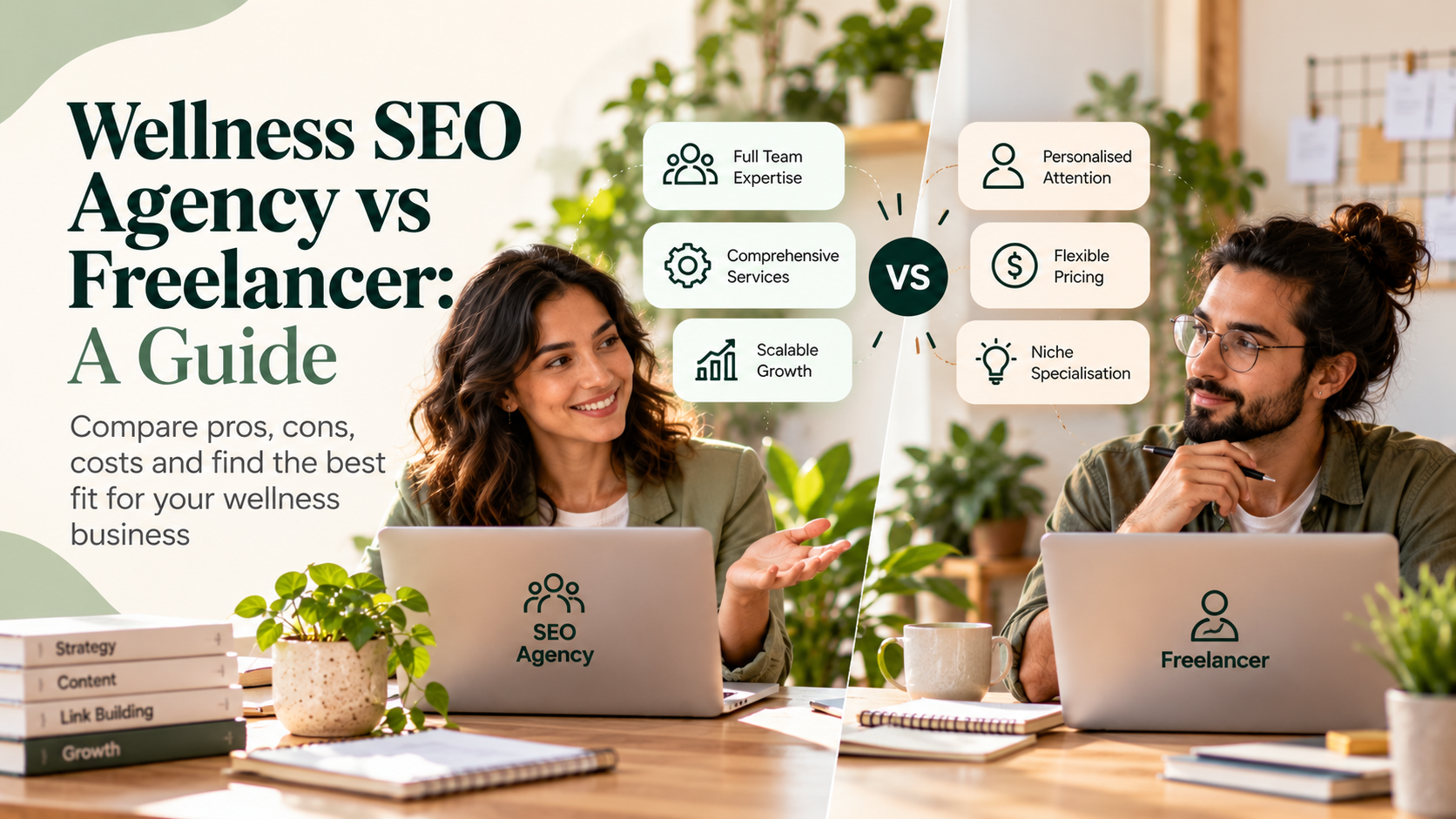
Introduction: The Real Choice Is About Capability
When a wellness practitioner starts looking for SEO help, the decision is often framed as agency versus freelancer. That framing hides the more useful question: what level of strategy, specialist knowledge, implementation and accountability does the business need right now?
A strong freelancer can be an excellent choice for a focused project. A specialist agency can be more practical when the work spans technical SEO, content, local search, website changes, analytics and ongoing strategy. There is also a hybrid option where an internal marketer works with an external specialist for complex tasks.
For wellness businesses, the decision has an additional dimension. The website may contain health-related information, practitioner credentials and claims that require care. A provider should understand the category rather than simply apply a generic SEO checklist.
1. What A Freelancer Can Do Extremely Well
A freelancer can offer direct access to the person doing the work. For a small website, that can be a major advantage. You may need a technical audit, keyword research, information architecture review, a handful of commercial pages or a clear strategy that your own team can implement.
The best freelancers often have very deep expertise in one discipline. A technical SEO specialist may be better for a migration than a general agency. A content strategist may be better for restructuring an existing library. A local SEO specialist may be ideal for a single-location practice.
The limitation is capacity. One person has finite time. If the project requires technical implementation, writing, editing, local SEO, digital PR, reporting and conversion optimisation at the same time, you need to understand which tasks the freelancer will actually perform and which will remain your responsibility.
- Direct communication with the person responsible for the work.
- Potentially lower overhead for a focused scope.
- Deep specialist knowledge in one discipline can be valuable.
- Flexible project structures can suit smaller businesses.
- Strong fit when the business already has implementation support.
2. What A Specialist Agency Can Add
The useful reason to hire an agency is not the label agency. It is the ability to coordinate several capabilities around one commercial strategy. A good specialist team can combine research, technical SEO, content, local search, website strategy and reporting without treating them as unrelated projects.
An agency can also provide continuity if one team member becomes unavailable. That does not make every agency better. Some agencies outsource nearly everything or assign work to junior staff after a senior sales process. You still need to ask who will actually execute the strategy.
Annurya's current service architecture illustrates one version of this model. Its services connect Wellness SEO with content, website strategy, local visibility and AI visibility. The important evaluation question is whether those capabilities are genuinely available and relevant to the client's situation.
3. Wellness SEO Requires Category Understanding
Wellness search behaviour can differ substantially by profession. A therapist may need strong practitioner information and local intent. A nutritionist may need service pages and educational content. A functional medicine practice may need condition and expertise clusters. A wellness coach may compete around goals, problems, modality and location.
This does not mean you must use a wellness-only agency. It means your provider should demonstrate that it understands the difference between professional categories and can explain why the search journey matters.
Reviewing existing educational work can help. Annurya's Wellness Coaches SEO Guide, Functional Medicine SEO Guide and Local SEO for Wellness Practitioners guide show how the same SEO principles are adapted to different search contexts.
4. Agency vs Freelancer: The Practical Comparison
Compare the provider against the work, not against the brand name. Ask who will create the strategy, who will implement technical changes, who will write or review content, who will monitor Search Console, and who will be accountable for the commercial outcome.
A freelancer may provide faster access and a narrower scope. An agency may provide broader capacity and process. Neither is automatically more strategic. The quality of the diagnosis and execution matters more than the number of people on the account.
- Strategy: who owns the plan and updates it when the evidence changes?
- Execution: who actually edits pages, fixes technical issues and publishes content?
- Content: who researches and reviews health-related material?
- Local SEO: who manages the profile and local relevance work?
- Measurement: who configures and interprets analytics and conversion events?
- Continuity: what happens if the main person becomes unavailable?
5. When A Freelancer May Be The Better Fit
A freelancer may be a strong fit when the problem is narrow and the business can execute internally. For example, a practice with a developer and content writer may only need an experienced SEO strategist to map search intent and prioritise the next quarter.
It can also work well when the business wants to learn. Direct access to a consultant can allow a founder or internal marketer to build capability rather than outsourcing the entire function.
Do not choose a freelancer only because the fee is lower. Compare the amount of work you will have to perform yourself. A low-cost consultant can become expensive if the business spends dozens of hours implementing recommendations that were assumed to be simple.
6. When A Specialist Agency May Be The Better Fit
An agency becomes more useful when there are several connected workstreams. A multi-location practice may need technical SEO, commercial page optimisation, local SEO, content and authority development. An international brand may also need market-specific architecture and localisation.
The same applies when the founder does not have time to implement recommendations. Strategy without execution does not create a finished result. If your internal team cannot publish pages, fix technical issues or manage content, the provider should have a credible implementation model.
An agency can also be useful when the business wants structured reporting and ongoing experimentation. Search performance creates new evidence every month, and a team can use that evidence to decide what should be improved next.
7. What Both Models Can Get Wrong
The most important failures are not caused by business model. They are caused by weak strategy. A freelancer can publish low-quality content just as easily as an agency can. An agency can build a large backlink report that adds little value just as easily as a freelancer can.
Common problems include creating pages for keywords with no business relevance, producing multiple articles that compete for the same intent, ignoring technical issues, reporting rankings without conversions, publishing health claims without adequate review, and creating location pages for places the business does not genuinely serve.
Google's SEO guidance encourages people-first content. Use that principle when evaluating both provider types. Ask whether the proposed work helps a real prospective client and whether the website becomes clearer as a result.
8. Communication Is Part Of The Product
SEO takes time, so communication quality matters. Ask how often the provider reports, whether you can review important content before publication, how technical changes are approved, and who you contact when something breaks.
A freelancer may offer very direct access to the senior person doing the work. An agency may use a strategist, project manager and delivery specialists. The best structure depends on your preference and the complexity of the engagement.
Whatever model you choose, you should understand what happened during the month, what the data says, what was learned and what will happen next. If the provider cannot explain the work in plain language, the problem is communication, not your lack of SEO knowledge.
9. Ownership And Access Matter More Than Most Buyers Realise
Your website, domain, Search Console property, analytics account, Google Business Profile and other critical digital assets should not become hostage to the provider relationship. Ask how access is handled before work begins.
Clarify content ownership, account ownership and what happens when the engagement ends. If a provider creates a dashboard, ask whether you can export the underlying data. If the agency edits the site, ask how changes are documented.
A professional provider should make your business stronger without making you dependent on access that only the provider controls.
10. The Hybrid Model Is Often The Smartest Option
You do not have to choose one provider for every task. A wellness business may keep social content in-house, hire a technical consultant for a migration, and use a specialist SEO agency for ongoing search strategy. Another practice may use an internal marketing person supported by an external strategist each quarter.
The correct model is the one that closes the capability gap. If you need strategy, buy strategy. If you need implementation, buy implementation. If you need both, choose a provider with credible capacity for both.
Hybrid arrangements can also reduce risk. You can retain internal knowledge while using outside specialists for areas that change quickly or require deeper expertise.
11. How To Evaluate The Provider Before Signing
- Ask for a diagnosis of your current visibility rather than a generic deck.
- Ask which commercial pages should be prioritised first.
- Ask what search intents those pages should own.
- Ask who will implement technical changes.
- Ask who writes and reviews health-related content.
- Ask how local SEO will be handled if the business is local.
- Ask what conversion events will be tracked.
- Ask who owns the website, analytics and search accounts.
- Ask what happens if the initial assumptions change.
- Ask what the monthly report will help you decide.
12. A Simple Decision Framework
Start by listing the work you need for the next 90 days. Separate strategy, implementation, content, local SEO and reporting. Then identify which tasks your team can genuinely execute.
If the work is narrow and your team can implement, a freelancer may be efficient. If the work spans several disciplines and you need execution, a specialist agency may be more practical. If the answer is mixed, use a hybrid model.
Do not buy complexity for its own sake. A small practice does not need a large team simply because it sounds impressive. Conversely, a multi-market practice should not choose a one-person solution that cannot realistically execute the required work.
13. The Questions That Reveal Quality
The best questions are not 'How many years have you done SEO?' They are questions that force the provider to explain how they think.
Ask: What do you think is currently limiting my visibility? Which pages would you improve first? What would you stop doing? Which queries matter commercially? How will you know whether a new article deserves to exist? What will you do if Search Console data contradicts the initial plan?
A strong provider should be comfortable changing the plan when evidence changes. SEO is not a script that can be written once and executed forever.
14. The Practical Bottom Line
A freelancer is not automatically cheaper in the long run, and an agency is not automatically more capable. The meaningful comparison is between the work required and the provider's ability to execute that work well.
For a focused project, a strong freelancer can be highly effective. For a complex ongoing programme spanning technical SEO, content, local search, website strategy and authority, a specialist agency may provide a more practical operating model.
Choose based on evidence, scope, expertise, communication, ownership and measurement. The business model is secondary to the quality of the operating system behind it.
How Annurya Fits The Decision
Annurya combines wellness SEO with related services rather than treating search as a disconnected task. Review its Wellness SEO Services page, Who We Serve framework and Case Studies before making a decision. Its blog also provides a useful way to evaluate how the team explains search strategy publicly.
The goal of this guide is not to tell every wellness business to choose an agency. It is to help you decide what capability you actually need and then evaluate providers on evidence rather than sales language.
Further Reading
Internal Annurya resources:
- Wellness SEO Services
- Case Studies
- Local SEO for Wellness Practitioners
- Wellness Coaches SEO Guide
- Functional Medicine SEO Guide