September 21, 2026 · By Anurag Paul Gummadi
Why Wellness Brands Must Master AI Visibility Now
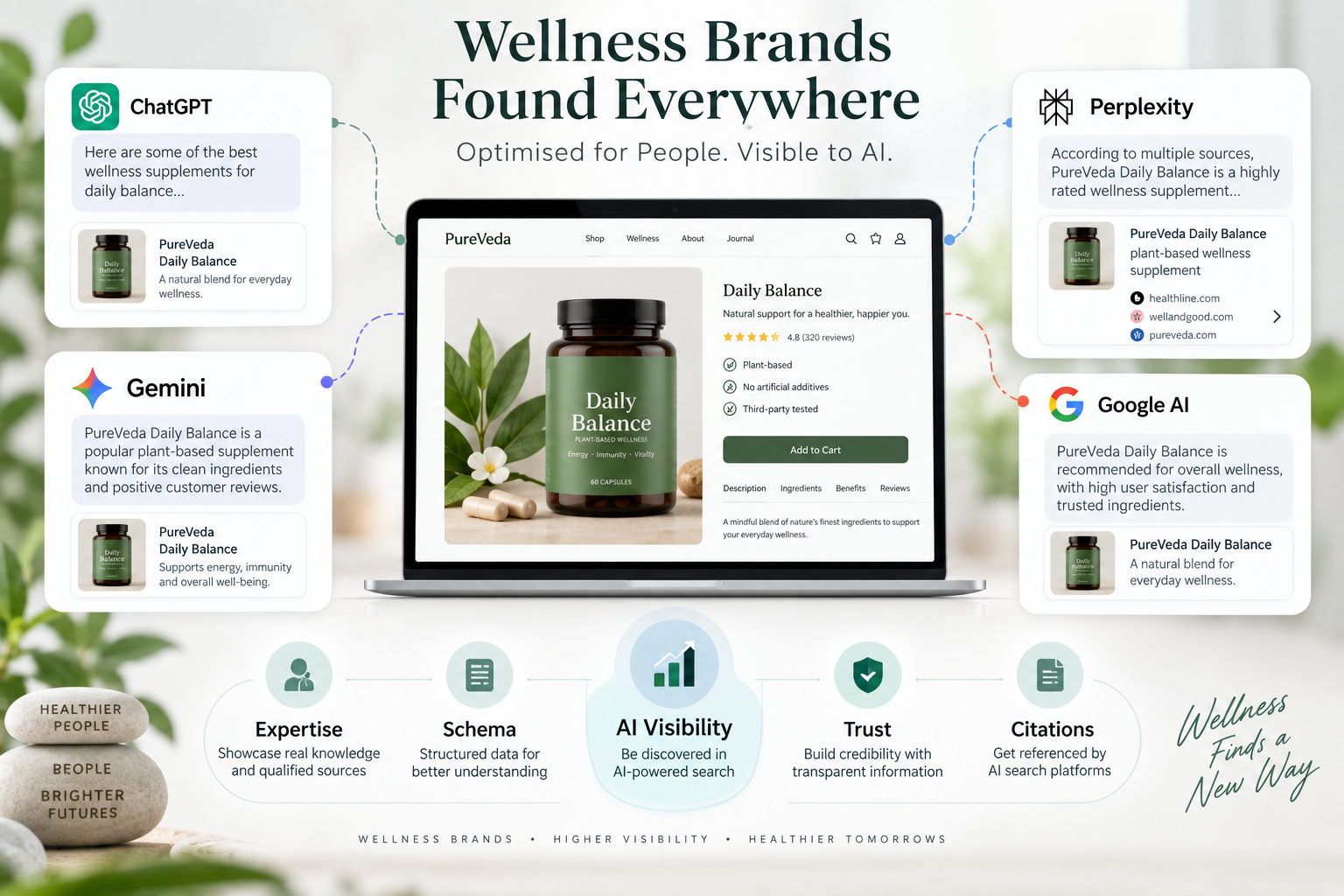
The way health consumers discover products and practitioners is shifting. Instead of typing a keyword into Google and scanning a list of blue links, more people are typing a question into ChatGPT, Perplexity, or Gemini and reading an AI-composed answer. For wellness ecommerce brands, this change introduces a new competitive dynamic: if your products and expertise are not cited in those answers, you are effectively invisible at the moment of decision.
The data signals urgency. Google's AI Overviews now appear on roughly 16% of ecommerce searches, and a recent survey found that 72% of marketers are already optimizing for Generative Engine Optimization (GEO). Health consumers in particular exhibit what Medico Digital's 2026 report calls "question-first" behavior — typing symptoms, safety concerns, and product comparisons directly into LLM platforms. Nearly one in ten Australians now ask AI tools the same health questions they used to type into Google.
GEO is not a replacement for foundational SEO. Technical SEO, crawlable product pages, clear site architecture, and useful content still provide the baseline for discoverability. What GEO adds is a layer that ensures AI platforms can understand, verify, and accurately represent a brand's products and expertise. Annurya's approach to GEO for health and wellness ecommerce focuses on making product information, ingredient details, credentials, and supporting evidence consistent and machine-readable, so AI systems have reliable material to work from when a user asks for a recommendation.
The question-first behavior also compresses the evaluation step. Many patients and shoppers decide whether a brand feels credible before they even open its website. A brand whose content is structurally clear, professionally attributed, and externally validated has a much stronger chance of being the one the AI chooses to cite. The stakes are highest in health and wellness, where AI platforms apply stricter harm-prevention filters and preferentially source from entities that demonstrate verifiable authority.
GEO Testing in Ecommerce: From Guesswork to Proof
From Keywords to Trust: The New Currency of AI Search
 Generative Engine Optimization (GEO) differs from traditional SEO in its target and tactics. SEO focuses on improving page rankings in search engine results. GEO, on the other hand, aims to increase visibility in the summary answers generated by AI platforms like ChatGPT, Gemini, and Perplexity. For health and wellness ecommerce brands, this means the goal shifts from ranking a page for a keyword to being a source that AI systems trust enough to cite.
The generative engine optimization process requires AI systems to recognize and verify your brand as a credible entity, not just find a keyword match. AI platforms prioritize sources that demonstrate strong Experience, Expertise, Authoritativeness, and Trustworthiness (E-E-A-T). Google’s own guidance confirms that optimizing for generative AI is still SEO at its core, but it demands a structure and credibility focus that traditional keyword work alone cannot provide.
For health brands, this trust validation follows a three-tier hierarchy. Tier one includes medical institutions and government agencies. Tier two covers licensed practitioners and accredited organizations. Tier three comprises commercial brands with proper expert backing and regulatory compliance. AI systems scan for credential markers like MD, PhD, or RD (Registered Dietitian). Annurya builds this trust framework by ensuring a brand's entity information, practitioner credentials, and supporting evidence are consistent and structured for AI platforms to find and reference safely.
Why Health Ecommerce Faces Higher AI Stakes
 Health and wellness ecommerce operates under a stricter set of rules than almost any other retail vertical. AI platforms treat health-related queries as high-risk, high-trust situations, applying what Google calls 'harm prevention' algorithms that prioritize institutional medical sources—like WebMD, Mayo Clinic, or government health agencies—over standard commercial pages. For brands selling supplements, skincare, or wellness products, this means a traditional product page with a generic description rarely appears in an AI-generated answer.
This dynamic is rooted in Google's Your Money or Your Life (YMYL) guidelines, which demand a level of demonstrated expertise that ordinary ecommerce content often lacks. As the E-GEO paper notes, AI models like ChatGPT and Gemini prioritize content from sources that show high E-E-A-T, especially for health topics, to reduce misinformation risk. A brand that cannot supply verifiable credentials, authoritative citations, or structured evidence will be passed over in favor of a recognized institution.
The consequences of AI invisibility are serious. When a generative engine answers a query like 'Which supplement is safest for joint pain?' and does not mention your product, you lose not only a potential sale but also the trust signal that comes with being cited by an AI. Over time, the brands that do appear consistently build a feedback loop: more citations lead to more authority, which leads to more citations—while the invisible brands stay invisible.
In Australia, the regulatory landscape adds another layer. Health brands must comply with the Therapeutic Goods Administration (TGA), the Australian Health Practitioner Regulation Agency (AHPRA), and the Australian Competition and Consumer Commission (ACCC). AI models favor compliant, evidence-based sources; content that breaches these provisions can reduce eligibility for AI citation. This addresses the challenge by ensuring that every product description, ingredient claim, and practitioner credential is both substantiated and structured for AI verification, giving compliant brands a clear advantage over those that treat health products like general merchandise.
The practical takeaway is that health ecommerce brands cannot rely on the same strategies as a fashion retailer. Every product page must show clear expert authorship, include health-specific schema markup (such as activeIngredient and dosageForm for supplements), and cite authoritative external sources. Educational content that answers safety and efficacy questions should form the bulk of your content library—70% education and safety, 30% product promotion, as recommended by industry guides. Without this layer of trust infrastructure, AI platforms will continue to recommend the competition.
Building an AI-Ready Product Foundation
 For health ecommerce brands, product pages are the core asset AI platforms draw on when generating recommendations. Making those pages AI-ready means moving beyond basic keyword optimization to a structured, verifiable data layer that platforms like ChatGPT and Google AI Overviews can interpret reliably.
The foundation is complete, consistent product data. Every SKU should carry accurate names, descriptions, categories, ingredients, and pricing — and that information must match across the brand's own site and external listings. Discrepancies between a product page and a third-party retailer's feed can cause AI systems to deprioritize or misrepresent the product.
Schema markup gives AI models a structured grammar for understanding that data. For supplements, use Product schema with fields like activeIngredient, dosageForm, and warning. When referencing a health condition, add MedicalCondition schema. Include NutritionInformation for food-based products and Review or AggregateRating schema to surface social proof. These markers help AI systems classify and recommend products with greater confidence.
Equally important is the language used in product descriptions. Raw technical specs (e.g., "1000 mg per serving") should be paired with human-readable phrases that answer the questions customers — and AI engines — are asking: "Who is this for?" and "What are the benefits?" Tools that normalize and enrich product attributes into conversational language improve both AI comprehension and conversion rates.
Annurya applies this approach by ensuring every product's information — from ingredient sourcing to practitioner credentials — is structured for verification, not just display. The goal is not to game recommendations but to make a brand's real expertise and product quality clear and citable, so AI systems have reliable material to work from across Google, ChatGPT, Gemini, and Perplexity.
Crafting Content That AI Engines Love to Cite
For health and wellness brands, the content that performs best in generative AI is the content built to be cited, not just read. AI systems favor pages that directly answer user questions with clarity, structured evidence, and expert attribution.
The 70/30 Rule: Education Over Promotion
Health-focused AI engines apply a harm-prevention lens to every source they evaluate. The most effective content split reserves 70% for education and safety context — ingredient guides, condition-specific explainers, and comparison resources — and 30% for product-specific information. This approach signals to AI models that the brand prioritizes genuine help over sales. Annurya builds content strategies around this ratio, treating every educational page as a trust signal that AI platforms can safely cite.
Putting Expertise on the Record
AI models scan for credentialed authorship as a core trust marker. Every product description, ingredient guide, and FAQ should carry clear attribution to qualified professionals, with author bios that include verified credentials (RD, RDN, ND, MD, PhD) and schema markup to make those credentials machine-readable. The E-GEO testbed framework confirms that content backed by peer-reviewed research and professional endorsements significantly outperforms marketing-fluff alternatives in AI-generated summaries.
Content written in neutral, data-backed language — avoiding superlatives and exaggerated claims — earns higher citation rates from ChatGPT, Perplexity, and Google's generative features. This is especially critical under YMYL (Your Money or Your Life) rules, where AI prioritizes sources that demonstrate verifiable expertise and transparent sourcing.
By weaving educational content, expert credentials, and evidence-based claims into a structured content hub, wellness brands position themselves as the authoritative source AI engines are most likely to recommend. For brands implementing this approach, Annurya's GEO services ensure that every piece of educational content is structured for entity recognition across both traditional search and AI discovery environments.
Beyond Rankings: Technical GEO and Schema Success
AI platforms like ChatGPT and Gemini rely on structured, machine-readable content to generate trustworthy recommendations. For Australian health and wellness ecommerce brands, that means getting the technical foundation right before expecting AI citations.
Speed and Crawlability — the Non-Negotiable Starting Point
Google's official guidance confirms that core SEO fundamentals — fast page speeds, mobile optimisation, and a clean site architecture — remain critical for generative AI search visibility. If your product pages take more than a few seconds to load or carry broken internal links, AI platforms have less incentive to include them in summaries. Annurya's GEO service builds on this by ensuring that technical SEO, indexable product pages, and clear site structure come first, creating a foundation AI systems can depend on.
Schema That Speaks to Health AI Systems
Generic Product schema is not enough. For wellness products, add activeIngredient, dosageForm, and warning properties (in Product schema), plus NutritionInformation for consumables and MedicalCondition schema when referencing health conditions. Review schema (star ratings, verified purchase badges) adds social proof signals that influence AI sentiment analysis.
Organisation schema should list the company's official name, logo, founder credentials, and direct URLs to professional registrations (e.g., AHPRA for Australian practitioners). Annurya helps brands align entity markup across their site and external profiles so that ChatGPT, Gemini, and Perplexity recognise the same authoritative signals consistently.
The Expert Advisory Board — a Credential Powerhouse
AI platforms scan for credential markers like RD, ND, PhD, MD, or DO when deciding which sources to cite. A dedicated 'Expert Advisory Board' page with detailed bios, licensing numbers, and Person schema markup signals institutional-grade authority. Brands that publish this page alongside health-specific content often see faster AI citation uptake than those relying on anonymous product copy.
Local Signals That Matter Beyond Google Maps
For Australian wellness brands, consistent NAP (name, address, phone) across Google Business Profile, local health directories (e.g., HealthEngine, Australian Natural Therapy Association listings), and local press coverage reinforces AI confidence. Include location-specific keywords in service page headings and FAQ blocks, since AI platforms weigh local relevance when recommending practitioners and nearby product suppliers.

Traditional SEO metrics like keyword rankings and organic traffic remain useful, but they do not tell the full story for GEO. Wellness brands need to track how often their products and practitioners are named, cited, or summarized inside AI-generated answers — not just when users click through to a website.
Core Metrics for GEO Performance
The primary measurement for GEO is AI visibility — the frequency with which your brand appears in responses from platforms like ChatGPT, Gemini, and Perplexity when users ask health-related questions. Related metrics include citation share (how often you are mentioned compared to competitors), sentiment of the mentions (positive, neutral, or negative), and branded search growth driven by AI recommendations.
Another useful indicator is referral traffic from AI platforms. When a generative engine cites your product page or article, some users will click through to learn more. Tracking how often this happens and which pages are cited most frequently helps you refine both content and technical structure.
Tools That Track AI Visibility
Google Search Console offers a Generative AI performance report that shows how content appears in AI Overviews and AI Mode. Third-party tools like Semrush, Profound, AthenaHQ, and Scrunch AI provide visibility scores, monitor mentions across multiple AI platforms, and benchmark your citation share against competitors. For wellness brands, these tools can track whether AI platforms are correctly identifying product ingredients, practitioner credentials, and evidence-backed claims.
Expected Timeframes and Audit Cadence
Initial AI visibility shifts are usually observable within 8 to 12 weeks of implementing a GEO strategy, with broader citation share growing over time. Set up a monthly audit cadence to review which prompts trigger your brand, how the context of mentions changes, and where competitors are appearing instead of you. These audits directly inform content updates, schema markup adjustments, and authority-building actions such as securing citations from professional health directories or peer-reviewed sources.
Annurya's GEO service includes ongoing AI visibility monitoring as part of its approach, ensuring wellness brands can see not just whether they appear in AI answers, but whether the information AI platforms present about their products and credentials is accurate. Regular adjustments based on audit findings keep the strategy aligned with how AI platforms evolve their sourcing behavior.
Real-World GEO Wins and the Path Forward
The shift from rankings to AI citation is not theoretical. Australian wellness ecommerce brands that have layered GEO onto strong SEO foundations are already seeing measurable gains.
One example is Chemist Australia, which achieved a 40% increase in organic revenue using a combination of SEO, SEM, and structured content. Another is Bondi Sands, which posted a 94% increase in keywords in Australia, 105% in the UK, and 54% in the US through coordinated SEO efforts. These results came from building E-E-A-T signals, structured data, and consistent messaging — exactly the approach that GEO formalises rather than replacing.
The Evolving GEO Landscape
GEO is not static. The platforms that matter today — ChatGPT, Gemini, Perplexity, Google AI Overviews — will continue to evolve, and new ones will emerge. The generative engine optimization practitioner's focus has already shifted from simple keyword placement to semantic relevance and entity recognition. For wellness brands, this means the strategy must keep pace: a product page optimised purely for Google Shopping in 2024 may not speak to the conversational, safety-first queries that AI platforms now surface.
Google's own guidance reinforces that optimising for generative AI features is still SEO. That means the fundamentals — crawlability, authoritative content, schema markup, clear brand identity — remain the bedrock. But brands that stop there are missing the new layer: ensuring that their information is structured for AI engines to reuse and cite, not just for humans to read.
A Blended Strategy Wins
The strongest results come from running GEO, traditional SEO, and AEO together. SEO gets content found; GEO gets content used; and AEO tailors answers for agentic experiences. For wellness ecommerce, local visibility adds another essential dimension. Many health queries carry local intent — 'supplement store near me' or 'best naturopath in Parramatta' — and AI platforms increasingly draw from local signals like consistent name, address, phone, operating hours, and clinician listings.
What sets a successful strategy apart is treating these channels as one cohesive system. A product page that ranks well in organic search but lacks clear authorship, third-party validation, or health-specific schema will rarely appear in an AI-generated answer. The blended approach ensures that every asset pulls its weight across both traditional and generative search surfaces.
Practical Next Steps for Wellness Ecommerce Brands
Brands ready to act should begin with a visibility audit across ChatGPT, Gemini, and Perplexity to identify where they are cited, where competitors appear instead, and where no answer exists at all. From there, the priorities are:
- Strengthen product schema — add activeIngredient, dosageForm, warning, and NutritionInformation markup for supplements and health products.
- Audit content for E-E-A-T signals — ensure every product description and educational page has clear authorship from a named, credentialed professional.
- Build a public proof layer — create dedicated pages for credentials, certifications, clinical backing, and expert advisory boards so AI engines have verifiable material to cite.
- Optimise for conversational queries — rewrite product and FAQ content to match the safety-first and condition-specific language real users type into AI.
Health and wellness ecommerce brands that invest in these signals today will be the ones AI platforms recommend tomorrow. The path forward is not about chasing every new platform — it is about building a foundation of clear, credible, structured information that any generative engine can trust.
The Road Ahead: Build a GEO Strategy That Converts
Building a GEO strategy that converts for health and wellness ecommerce requires more than layering AI optimization on top of your existing SEO. It means reshaping how your brand presents itself across every digital signal—product data, content, entity consistency, and technical structure—so that AI platforms can find, verify, and cite you with confidence.
Integrate GEO Into Your Existing SEO and Content Marketing
The most effective approach combines traditional SEO fundamentals with GEO-specific tactics. Google itself states that optimizing for generative AI search is still SEO—so your existing technical foundation, site structure, and content quality remain essential. The GEO layer adds entity clarity, structured evidence, and a focus on how your brand is summarized and cited across AI platforms like ChatGPT, Gemini, and Perplexity. For wellness ecommerce, this means ensuring product names, categories, ingredients, and intended uses are consistently represented and machine-readable.
Start by auditing your product data and content for completeness and accuracy. Every SKU should carry clear, non-promotional descriptions, proper category assignments, and health-specific schema markup such as activeIngredient and dosageForm. Then build content hubs—educational guides, ingredient explainers, safety FAQs—that answer the real questions buyers ask during the research phase. When AI platforms synthesize answers, they pull from this structured, authoritative content first.
Own Your First-Party Data and Content
As AI platforms absorb more of the customer journey, first-party data and owned content become your most resilient assets. Email lists, customer behavior dashboards, and proprietary research give you signals that no third-party tool can replicate. Health brands that publish original case studies, anonymized outcome data, and unique product testing results create material that AI engines cannot find anywhere else—making them more likely to be cited.
Treat your content as a decision-support system, not a marketing page. Organize it into clusters around specific conditions, ingredients, or wellness goals. Each page should carry clear author attribution with credentials (RD, ND, PhD) and links to the supporting research. When AI scans your site for trust signals, this transparency is the difference between being cited and being skipped.
Avoid Common Pitfalls That Kill AI Visibility
The biggest mistakes wellness brands make with GEO stem from treating health products like generic ecommerce. Publishing content without expert review, using promotional language without safety context, and neglecting technical SEO (schema, site speed, crawlability) all signal to AI platforms that your brand is not a reliable source. Health and wellness ecommerce operates under Google's YMYL (Your Money or Your Life) guidelines, which means AI applies harm-prevention algorithms that favor institutional and credentialed sources over unsubstantiated claims.
Another common error is failing to monitor AI visibility. Without tracking which platforms cite your brand and in what context, you cannot adjust your strategy. Tools that measure citation share, sentiment, and prompt coverage across ChatGPT, Gemini, and Perplexity help you identify gaps and opportunities. Annurya's approach to wellness GEO emphasizes making a brand's real products and expertise clearer and better connected—not manufacturing recommendations through generic claims or keyword-heavy copy.
Take a Phased Approach: Start With Foundations, Then Scale
A phased rollout prevents overwhelm and ensures each layer is solid before adding the next. Phase one focuses on technical and content foundations: resolve crawlability issues, implement health-specific schema markup, and audit product data for consistency. Phase two introduces content optimization: rewrite product descriptions with safety context, create educational hubs with expert attribution, and build FAQ and comparison pages that answer common AI prompts. Phase three adds off-page authority and monitoring: secure guest posts on professional health sites, earn mentions in authoritative directories, and set up dashboards to track AI citation trends.
Wellness brands that start with strong foundations and then scale their GEO efforts see the most sustainable gains. The objective is not to chase every AI platform at once but to make your brand so clear, consistent, and evidence-backed that AI systems naturally include you in their answers. When your product information, practitioner credentials, and supporting research are easy for AI to verify, you earn the recommendations that drive real traffic and sales.
From Discovery to Trust: The Future of Wellness Visibility
GEO is not about gaming AI systems or manufacturing fake recommendations. The consistent message across Google’s official guidance, academic research (E-GEO framework), and every credible agency in this space is the same: GEO works by making your genuine expertise, real products, and substantiated claims easier for AI platforms to find, understand, and cite accurately.
That process starts with a solid traditional SEO foundation — crawlable pages, clear site architecture, fast load times, and indexable product content. Without those basics, AI systems cannot reach your content at all. The GEO layer adds entity clarity, structured trust signals, and content designed for citation, not just ranking. For wellness ecommerce brands, Annurya’s approach reflects this dual need: it builds on technical SEO while adding the entity and evidence signals AI platforms require to confidently recommend a practitioner or product.
The path forward for any wellness brand is concrete. Begin with an AI visibility audit: check where your brand appears in ChatGPT, Gemini, and Perplexity today. Identify gaps in product clarity, credential visibility, and content structure. Then build the GEO layer — clear product attributes, expert-attributed content, consistent entity signals — on top of your existing SEO. The goal is not to chase rankings in a traditional sense but to become the source AI engines trust to answer health and wellness questions accurately.