September 21, 2026 · By Anurag Paul Gummadi
Building Trust Signals That Get ADHD Coaches Recommended
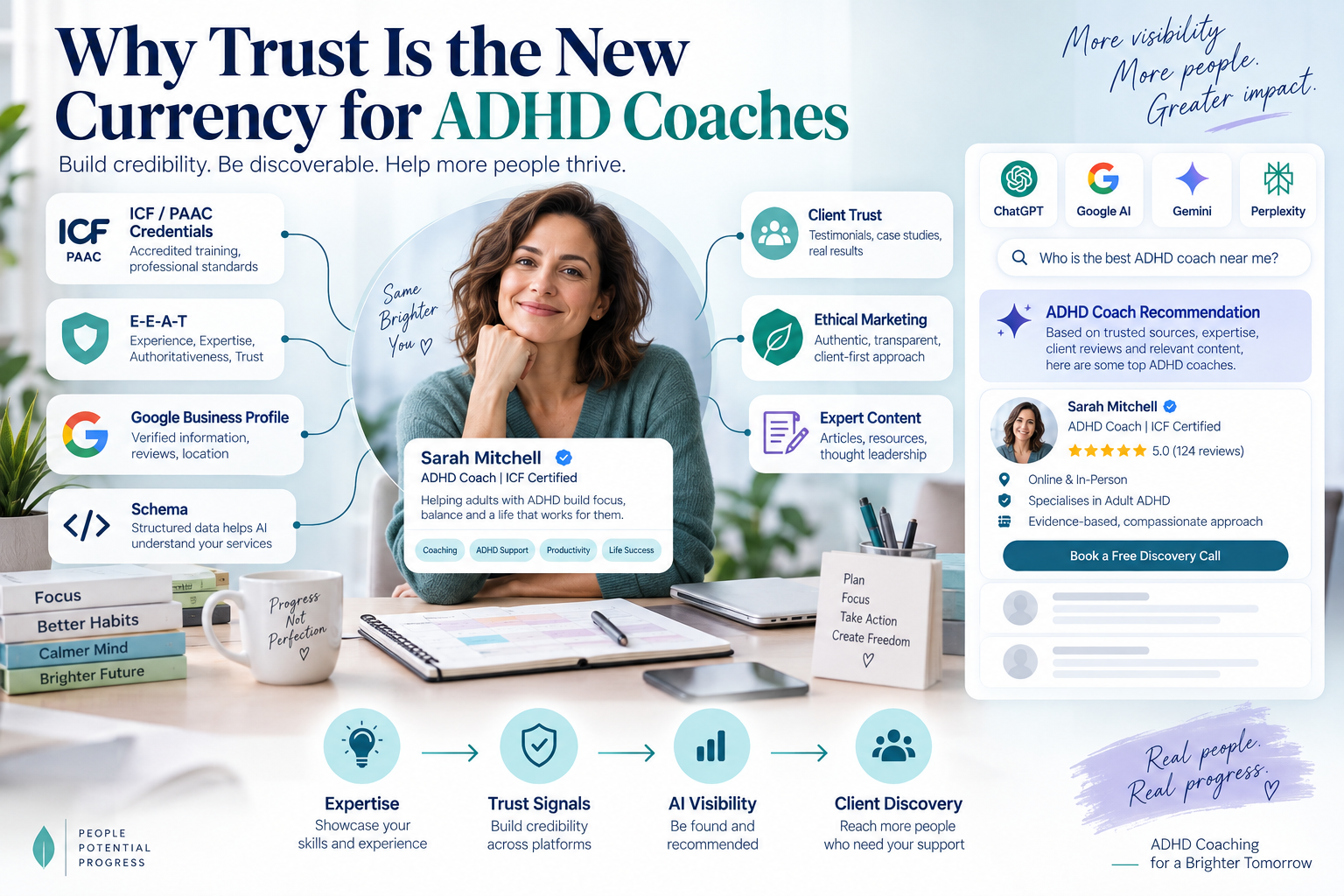
Why Trust Is the New Currency for ADHD Coaches
The ADHD coaching field has boomed in recent years, yet it operates with no formal licensing or standardized oversight. Anyone can call themselves an ADHD coach, which makes trust the single most important signal clients — and the algorithms that serve them — rely on.
Expertise alone no longer guarantees discovery. In a crowded market where a recent CHADD report confirms the field is unregulated, prospective clients turn to Google, AI assistants like ChatGPT, and directory platforms to find a coach. These systems evaluate credibility through visible, structured signals — credentials, consistent entity information, and content that demonstrates real understanding of ADHD — not just a well-designed website.
This article maps how ADHD coaches can earn and display the trust that both humans and AI demand. You'll learn why ethical standards matter for search visibility, how to structure your online presence for AI platforms, and what specific trust signals move clients from discovery to booking.
For health-focused professionals navigating this landscape, services like those offered at www.annurya.com specialize in building the structured authority that makes AI platforms confident enough to recommend a practice — turning ethical, credential-forward work into measurable online growth.
ADHD & Learning How To Trust Your Gut With Caroline Maguire
The ADHD Coaching Standards Crisis
 Unlike fields with mandated oversight, ADHD coaching operates without a formal licensing body or standardized regulatory framework. While organizations like the International Coach Federation (ICF) and the Professional Association of ADHD Coaches (PAAC) offer credentials, anyone can legally call themselves an ADHD coach. This absence of gatekeeping means trust cannot be assumed from a title alone — it must be demonstrated through consistent, observable behavior.
For coaches, this standards gap presents an opportunity. When the market lacks uniform benchmarks, professionals who voluntarily adopt and publicize clear ethical standards stand out. Annurya specializes in translating such trust signals — verifiable credentials, documented ethics policies, and transparent business practices — into structured data and content that AI platforms and search engines use to recommend practitioners. In a field with no official oversight, being the coach who proactively communicates competence becomes a competitive advantage.
The Five Ethical Standards That Build Trust
Research and industry guidance converge on five core standards that ethical ADHD coaches follow to build trust with clients and referral sources alike.
- Confidentiality. Clear privacy policies, explicit consent before recording, and secure handling of client notes create the psychological safety needed for honest coaching work.
- Clear Scope. Naming exactly what coaching does and does not cover — including where to refer clients for therapy, medical advice, or diagnosis — prevents role confusion and protects both parties.
- Equity and Humility. Honoring neurodiversity through flexible session formats, simplified systems, and strengths-based framing ensures coaching is accessible to clients with varied processing needs.
- Competence. Ongoing ADHD-specific education, supervision, peer consultation, and staying current with research distinguish specialized coaches from general practitioners.
- Integrity. Transparent fees, accurate claims about training, and disavowal of shame-based sales language align marketing with care. Promise only support, not guaranteed transformation.
Wellness SEO vs. Traditional SEO
 Wellness SEO is not traditional SEO with a health-themed wrapper. It is a specialized discipline built for high-stakes, high-trust categories where search engines and AI platforms apply strict quality thresholds. For an ADHD coach, the difference between being recommended by Gemini or buried on page five often comes down to whether the site signals trustworthiness and verified expertise, not keyword density.
Traditional SEO has historically focused on keyword volume, backlink quantity, and domain authority. Wellness SEO, by contrast, prioritizes trust signals. Google's YMYL (Your Money or Your Life) classification applies to health and wellness content, including ADHD coaching, meaning the platform holds it to the highest E-E-A-T standards. A site that relies on keyword stuffing without showing real credentials, client outcomes, or transparent business practices will struggle to earn visibility. The goal is to build credibility that satisfies both algorithmic evaluation and the cautious, identity-driven search behavior of someone seeking ADHD support.
The Three Layers of Discoverability
A structured framework can help wellness professionals move from invisible to AI-recommended. The model uses three layers: technical foundations (Core Web Vitals, crawlability, schema markup), topical authority (deep content clusters and strong E-E-A-T signals), and AI-readable structure (structured FAQ, answer-first formatting, and consistent entity signals for platforms like ChatGPT, Gemini, and Perplexia). Annurya applies this framework specifically for health-focused brands, connecting genuine expertise with the structured signals that modern search and AI systems use to safely recommend practitioners.
For ADHD coaches, wellness SEO means targeting specific, high-intent queries that go far beyond the head term "ADHD coach." Prospects search for affirming language, lived-experience credibility, and practitioners who understand neurodiversity. A purely technical SEO approach misses these nuances. The more precisely content signals real understanding—through session-structure details, named mechanisms like body doubling or task breakdown, and consistent credential information across directories—the more both human readers and AI assistants will trust the practice enough to recommend it.
AI Visibility and GEO for Health Brands
 For ADHD coaches and other wellness professionals, visibility now means being cited inside an AI answer, not just ranking on a search results page. When a potential client asks ChatGPT or Perplexity for an ADHD coach in their area, the brands that get recommended are those whose structured data, credentials, and topical authority are legible to AI platforms. This emerging discipline is often called Generative Engine Optimization (GEO).
Because health and coaching fall under Google’s YMYL (Your Money or Your Life) classification, AI systems apply stricter accuracy filters before surfacing any recommendation. A coach whose site lacks verifiable credentials, consistent entity signals, or primary-source citations is unlikely to be cited. GEO builds on standard SEO by adding MedicalEntity and Person schema markup, answer-first content structures, and independent corroboration from authoritative sources.
Annurya extends this same framework as part of its specialized wellness SEO, helping ADHD coaches structure pillar content around condition-specific search intent and earn off-domain authority from health directories and trade press. A practical first step is to ensure name, credentials, and specialty appear identically across every platform — your Google Business Profile, website copy, directory listings, and social profiles must send a unified signal. Coaches can also begin monitoring AI share-of-voice by tracking whether their practice is mentioned in AI-generated answers and which sources those systems reference instead.
E-E-A-T: The Trust Framework AI Depends On
Google’s E-E-A-T framework — Experience, Expertise, Authoritativeness, Trustworthiness — is the standard against which YMYL (Your Money or Your Life) content like ADHD coaching is evaluated. While not a direct ranking factor, it guides Google’s human quality raters and shapes the algorithmic signals that determine visibility.
For wellness professionals, demonstrating each E-E-A-T pillar requires deliberate action.
- Experience is best shown through detailed client stories and case studies that describe real coaching outcomes.
- Expertise calls for visible credentials — author bios with certifications from bodies like the International Coach Federation or the Professional Association of ADHD Coaches — plus content that references current research.
- Authoritativeness grows from backlinks in reputable health directories and media mentions, while Trustworthiness depends on transparent policies, HTTPS security, and accurate, non-exaggerated claims.
AI platforms such as ChatGPT and Gemini rely on the same trust signals to decide whether to recommend a practitioner. Structured data markup — MedicalBusiness or Person schema — helps these systems parse credentials and affiliations consistently. Annurya builds E-E-A-T-aligned content strategies that combine verifiable credentials, structured data, and authoritative publishing so that coaches appear as trusted, citable sources across both Google and generative AI ecosystems.
Entity Recognition: Why AI Must Know Who You Are
What Is Named Entity Recognition and Why Does It Matter for Health Professionals?
Named entity recognition (NER) is the artificial intelligence process that automatically identifies and classifies real-world subjects like people, organizations, locations, and certifications within your content. When an AI platform reads a web page or a coach directory listing, NER extracts the specific nouns that define a practitioner — for example, "Jane Doe, PCC, ADHD-affirming coach in Sydney" — and maps them into a structured knowledge graph. For ADHD coaches and other health professionals, this process is how search engines and AI assistants like ChatGPT, Gemini, and Perplexity distinguish a real, verifiable provider from a generic name. NER determines whether a system can safely recommend a practitioner in an AI-generated answer.
Once NER identifies the entities on your site, AI platforms populate internal knowledge graphs that store facts about who you are, what you offer, and where you practice. These graphs power the AI's ability to retrieve and cite a professional when a user asks a relevant question. For a health professional, being recognized as a clear, credible entity — like "ADHD-affirming coach" or "holistic nutritionist with verified credentials" — is critical because AI uses this structured information to decide whom to recommend. Practitioners with strong entity signals appear in AI-generated answers; those without them remain invisible to the modern discovery ecosystem.
Entity recognition fails when a professional's name, credentials, and specialty appear differently across their website, directory listings, Google Business Profile, and social media. AI systems treat "Jane Doe, ADHD Coach" on one platform and "Dr. Jane Doe, Executive Function Specialist" on another as two separate people, diluting the authority signal for both profiles. Consistency in naming, credentials, and specialty descriptions across every web property — using the same exact phrasing — is the simplest way to strengthen entity recognition. This alignment helps both prospective clients and AI platforms understand exactly what the practice does.
Structured Data Markup for People and Organizations
Structured data markup — specifically Person schema for individual practitioners and LocalBusiness or Organization schema for practices — gives search engines and AI platforms explicit, machine-readable labels for the entities on a site. When you add schema that specifies "name: Jane Doe, jobTitle: ADHD Coach, credential: PCC, areaServed: Melbourne", you remove any ambiguity about who the person is and what authority they hold. Schema markup does not directly boost rankings, but it tells Google's Knowledge Graph and AI platforms exactly which entity facts to index. For ADHD coaches and wellness professionals operating in a YMYL (Your Money or Your Life) category, this markup is a foundational trust signal that AI depends on for confident recommendations.
Annurya helps health professionals implement entity-based content strategies that build these consistent signals across all digital touchpoints. By designing web pages and structured data that explicitly name the condition (ADHD, AuDHD), the need (executive function, rejection sensitivity), and the service (coaching), Annurya's approach ensures that AI platforms can safely retrieve and recommend practitioners. Entity consistency is not an afterthought in their framework: it is built into AI-readable structure and E-E-A-T content. For ADHD coaches who want AI to know exactly who they are, structured entity signals are non-negotiable.
Google Business Profile and Personal Branding as AI Signals
For wellness professionals, a well-optimized Google Business Profile (GBP) is more than a local listing—it is a foundational trust signal for AI-driven recommendations. Google uses relevance, distance, and prominence to surface practices in local packs and AI-generated results. For practitioners with high E-E-A-T needs, a complete, verified GBP with current hours, responsive reviews, and regular posts directly signals authority to both Google and large language models like ChatGPT and Gemini.
Personal branding builds the entity profile that AI platforms rely on for safe recommendations. Consistent credentials, expert content, and professional associations create the structured data and trust signals that make a coach a verifiable specialist. Rather than treating GBP and branding as separate efforts, integrating them ensures visibility across Google, ChatGPT, and Perplexity—not just traditional local search.
Annurya combines GBP optimization with personal branding into a single, cohesive strategy. For ADHD coaches specifically, the ADHD Coach SEO services at www.annurya.com align profile consistency, structured data, and credential-forward content so that AI systems can confidently verify and recommend a practice. When both elements work together, a coach becomes discoverable wherever clients search—without repeating the same trust signals across platforms.
What Credentials Actually Matter for ADHD Coaches
ADHD coaching is not a licensed profession, which means the credentials a coach holds are the primary signal a prospective client (and AI platforms) have for judging competence. The most recognized general coaching credential comes from the International Coaching Federation (ICF), which offers three levels: Associate Certified Coach (ACC), Professional Certified Coach (PCC), and Master Certified Coach (MCC).
For clients specifically seeking ADHD expertise, the Professional Association for ADHD Coaches (PAAC) credentials carry more weight. PAAC is the only global body dedicated exclusively to ADHD coaching, awarding the Certified ADHD Coach Professional (CACP), Professional Certified ADHD Coach (PCAC), and Master Certified ADHD Coach (MCAC) designations. These credentials require both general coaching training and specialized ADHD coaching education.
The ADD Coach Academy (ADDCA) is another respected route. It was the first comprehensive ADHD coach training program and is accredited by both the ICF and PAAC. Completing an ADDCA program does not automatically grant a credential, but it does signal that a coach has received ADHD-specific training from an institution that meets independent standards.
Lived Experience vs. Formal Training
Many effective ADHD coaches have ADHD themselves. Lived experience can produce deep empathy and a practical understanding of executive function struggles that formal training alone cannot replicate. But the most trusted coaches combine personal insight with formal education. A coach who holds an ICF credential and a PAAC specialty certification, and who also openly shares their own ADHD journey, offers the widest trust signal for both human clients and AI recommendation systems.
For AI discoverability, structured data should list every certification, credential, and membership clearly. Consistency across the website, Google Business Profile, directory listings, and the coach's LinkedIn profile creates the entity signals that AI platforms like ChatGPT and Gemini rely on when recommending practitioners.
What to Feature for Maximum AI Trust
- ICF credential. Include ACC, PCC, or MCC level; link to the ICF verification page or credential badge.
- PAAC credential. List CACP, PCAC, or MCAC; this signals an ADHD specialty that general ICF training does not cover.
- Training institution. Name the accredited program (e.g., ADDCA, JST Coaching) and include the institution as a recognized entity in your schema markup.
- Personal lived experience. If the coach has ADHD, mention it in the bio page and about section. AI platforms map personal stories to the Experience component of E-E-A-T.
When a coach displays these credentials with consistent naming and linking across the web, they build a trustable digital identity. For wellness professionals and health-focused brands working with Annurya, this consistency is part of the Layer 2 (Topical Authority) and Layer 3 (AI-Readable Structure) framework — giving both clients and AI systems the confidence to recommend the practice.
Ethical Marketing That Builds Trust, Not Hype
Ethical marketing for ADHD coaches begins with integrity and transparency. That means making accurate claims about training and experience, avoiding shame-based or countdown-pressure sales language, and disclosing affiliate links or financial partnerships. When marketing positions coaching as meaningful support rather than a guaranteed transformation, it aligns with the trust signals that both prospective clients and AI platforms reward.
- Accurate Claims. Coaches should state precisely what training, certifications, and experience they hold, avoiding exaggeration. This builds credibility that AI systems like ChatGPT and Gemini can detect through consistent entity signals and structured data.
- Pressure-Free Language. Ethical ADHD coaches avoid phrases that imply scarcity or shame, such as "limited spots" or "stop struggling." Instead, they frame offers as honest invitations, which reduces bounce rates and improves trust metrics that influence E-E-A-T evaluations.
These practices directly support E-E-A-T — particularly the Trustworthiness component. Google's quality raters look for transparency in who created content and why. For ADHD coaches listed in directories or verified by organizations such as the ADHD Coaches Organization, consistent claims across all platforms reinforce authoritativeness and make it easier for AI platforms to recommend them safely.
Content That Signals Real Understanding of ADHD
Generic phrases like "judgment-free" or "understanding" do little to signal genuine expertise to someone researching an ADHD coach. Prospective clients often arrive after repeated failed attempts at standard productivity advice, feeling skeptical and overwhelmed. Content that names the specific struggle — executive function, task paralysis, rejection sensitivity — reads as lived experience rather than a template.
For example, writing "sessions restructure week to week instead of following a fixed plan" demonstrates real understanding of ADHD's variable energy and focus. Similarly, targeting long-tail keyword variations around adult diagnosis, AuDHD identity, and time blindness captures high-intent search behavior that generic "ADHD coach" pages miss. The ADHD Coaches Organization notes that thorough research on a coach's specialized knowledge is essential before hiring.
Content should also be tailored to different diagnosis stages and age groups. A newly diagnosed adult seeking self-understanding needs affirming, identity-focused language, while a parent looking for adolescent coaching wants concrete strategies around homework and routines. Naming the specific age group, diagnosis stage, or struggle — and backing it with practical examples — signals real competence rather than surface-level awareness. Annurya builds this kind of condition-specific topical authority into its visibility strategies, helping coaches create content that matches the precise language their ideal clients use when searching.
The Role of AI Tools in an ADHD Coach’s Ecosystem
AI tools have become valuable assistants for adults with ADHD, helping with the core challenges that coaching targets—task initiation, time management, and organization. Tools like ChatGPT break through writing paralysis by generating drafts without the weight of perfectionism, while apps such as Goblin Tools break overwhelming tasks into tiny first steps, reducing the cognitive load that often stalls progress. These tools act as on-demand executive function supports, particularly useful when mental energy is low.
However, AI is a complement, not a replacement, for human coaching. A tool cannot notice the non-verbal cues that signal a client is shutting down, cannot challenge all-or-nothing thinking patterns, and cannot provide the shame-free accountability that builds sustainable self-trust. The most effective ADHD support ecosystem combines human coaching for self-understanding and strategy with AI tools to reduce cognitive load between sessions.
Guiding Clients on Responsible AI Use
ADHD coaches have a responsibility to discuss privacy and data security with clients. Many AI tools require personal information—task lists, emotional check-ins, notes on executive function patterns—without the confidentiality protections a coaching session carries. Coaches should advise clients to use tools without sharing identifiable details, avoid platforms with opaque data policies, and treat AI-generated suggestions as prompts to discuss with a trusted human, not as definitive guidance.
Building trust also means being transparent about what AI cannot do. AI runs scripts and lacks the pattern-recognition capacity to track a client's progress over months, notice when motivation dips, or understand the emotional nuance behind procrastination. When coaches address these limitations directly, they reinforce the value of the human relationship—and position themselves as guides who combine ethical practice with smart tool use, exactly the kind of trustworthy expertise that AI platforms look for when making recommendations.
Measurable Growth for Health-Focused Brands
Health-focused brands using thoughtful visibility strategies can expect growth that is both tangible and trackable. One of the first measurable signals is an increase in brand citation frequency within AI-generated answers from platforms like ChatGPT, Gemini, and Perplexity. These citations occur when your structured data, E-E-A-T signals, and consistent entity information make you a safe, authoritative recommendation for the AI.
Qualified website traffic from AI referrals is another hard metric. Visitors arriving from these channels tend to have high purchase intent, with data showing conversion rates near 7%. Over time, AI-influenced prospects who first encounter your name in an AI response will seek you out directly, raising your branded search volume—a clear sign that AI-mediated discovery is feeding traditional search interest.
- Brand Citation Frequency. How often your brand is named in AI-generated answers for wellness queries. More citations mean higher visibility share among competing practitioners.
- Qualified AI Referral Traffic. Website visits originating from AI platforms. For health brands, these visitors convert at approximately 7%, well above average for general web traffic.
- Enhanced Branded Search Volume. The rise in direct searches for your name by prospects who were first introduced to you through an AI answer, bridging AI and traditional search.
- AI Brand Mention Value (ABMV). A framework for quantifying visibility ROI by calculating the attention-weighted value of each AI citation and attributing demand even from zero-click discovery journeys.
Frameworks like AI Brand Mention Value (ABMV) help turn this into ROI language. ABMV calculates the attention-weighted value of each AI citation, attributing demand even through indirect, zero-click discovery paths. When you pair this with consistent tracking of traditional search rankings and conversion rates, you get a complete picture: growth rooted in verifiable authority signals that translate into higher trust and revenue from both AI-mediated and conventional search channels.
Common SEO Mistakes That Erode Trust
Publishing volume over depth is the fastest way for an ADHD coach to lose credibility with both clients and search engines. Google's E-E-A-T framework rewards content that demonstrates genuine expertise and first-hand experience, not generic blog posts that skim the surface. A coach who writes ten shallow articles about "time management tips" will rank behind a competitor who publishes one detailed guide on breaking task paralysis for the ADHD brain, backed by real session outcomes and clear author credentials.
Technical health is another common blind spot. Slow load times, poor mobile responsiveness, and insecure HTTP connections signal untrustworthiness to Google and human visitors alike. For wellness professionals, a site that takes more than three seconds to load can lose half of potential clients before they read a single word. Regular performance audits and HTTPS enforcement are baseline requirements for any practice serious about online visibility.
Missing schema markup and inconsistent NAP (name, address, phone number) data create confusion for AI platforms trying to verify a coach's identity. Search systems use structured data to confirm who you are, what you do, and where you practice. When an ADHD coach's Google Business Profile lists one address, their website mentions a different suburb, and their directory listings are scattered, AI assistants like ChatGPT and Gemini cannot safely recommend them. Simple fixes—such as implementing Person or LocalBusiness schema and ensuring every external citation matches—close that gap.
Many practitioners also optimize exclusively for Google while ignoring AI retrieval. The same content that ranks on search results today may be invisible to AI assistants if it lacks answer-first formatting, consistent entity signals, and corroborating sources. This approach addresses this by building for the full AI ecosystem—ChatGPT, Gemini, Perplexity—alongside traditional Google ranking.
Beyond technical issues, the language coaches use in their content directly affects trust. Generic phrases like "judgment-free space" or "understanding" fail to signal real expertise. Saying a coach offers "flexible sessions" without describing what flexibility looks like reads as a template, not a genuine practice detail. Naming the specific mechanism—"sessions restructure week to week instead of following a fixed plan"—signals actual lived understanding.
Unrealistic promises and blame-based messaging are the most damaging mistakes of all. Promising a "quick fix" for executive dysfunction or using countdown-pressure sales language erodes the safety that ADHD clients require. Ethical marketing positions coaching as meaningful support, not a guaranteed transformation. Coaches who avoid exaggeration and instead focus on transparent, affirming language build the trust that AI platforms and prospective clients depend on.
From Credentials to AI Recommendations
Trust in ADHD coaching is built from two things: visible ethics practiced consistently and structured signals that make those ethics legible to both people and machines. The ethical standards explored earlier — confidentiality, clear scope, cultural humility, competence, and integrity — are not abstract values. They are operational choices that shape how a coach collects intake forms, sets fees, handles group sessions, and frames marketing claims. Those same choices, when presented as structured data, consistent entity signals, and transparent credentials on a coach's website, become the raw material that AI platforms use to decide whether to recommend a practitioner.
The moment demands that coaches act deliberately on this connection between ethics and discovery. The ADHD coaching field sits inside a YMYL category where Google applies its strictest quality standards, and AI assistants such as ChatGPT and Gemini now function as search gatekeepers for health-related services. A coach who trains clients with genuine ADHD-affirming methods but does not signal that expertise through an explicit author bio, E-E-A-T-structured content, and consistent NAP data across health directories will remain invisible to the very people searching for affirming, credible support. Generic 'ADHD-friendly' language without depth reads as a template; naming the specific mechanism — how sessions adapt to time blindness, why flexible structure builds self-trust — signals real understanding.
Annurya helps coaches turn their hard-won expertise into verifiable authority by building the structured signals that AI platforms require. The Annurya framework addresses the pain point that expertise alone does not guarantee discovery: well-rounded wellness SEO, entity-recognition strategies, and E-E-A-T content designed for the modern AI ecosystem rather than just Google. For the ADHD coach who has invested in specialized training, ethical boundaries, and lived understanding, the missing piece is often not better coaching — it is a visibility infrastructure that makes that quality unmistakable to both prospective clients and the AI that serves them.
When trust signals are clear, AI recommends confidently. The coach who publishes consistent credentials, uses structured data to mark their certification and specialty, and writes content that names the specific struggles of adult ADHD — rejection sensitivity, executive function fluctuation, task paralysis — creates a foundation that Google's E-E-A-T guidelines reward and that AI assistants can safely cite. The work of building trust does not stop at the coaching session. It extends into every digital touchpoint where a potential client decides whether this practitioner is credible, affirming, and worth the investment.